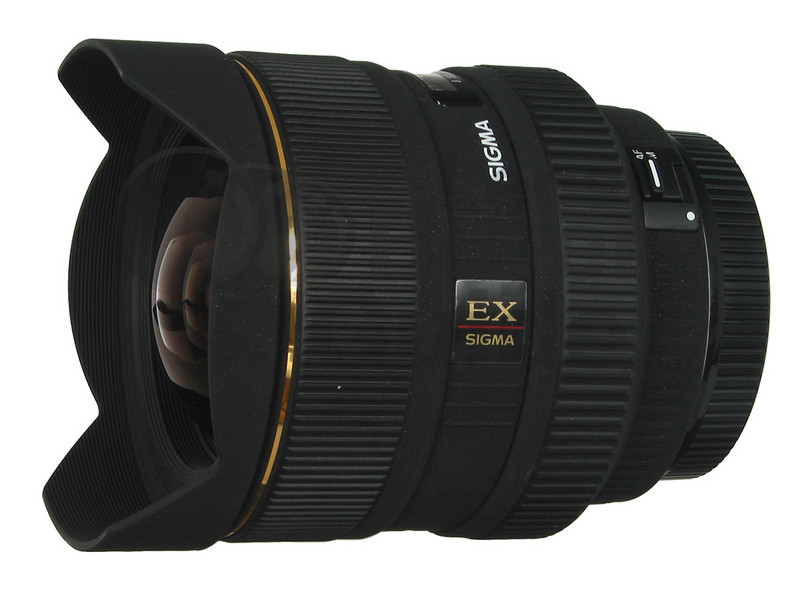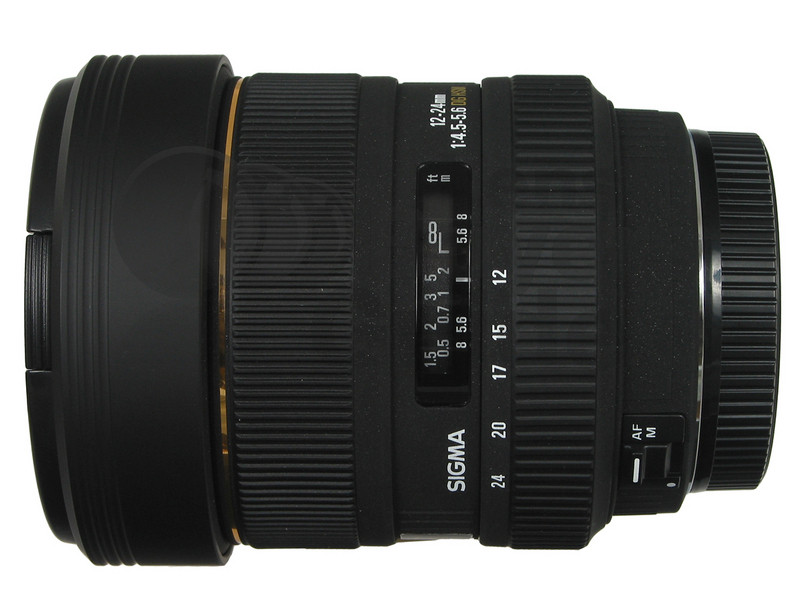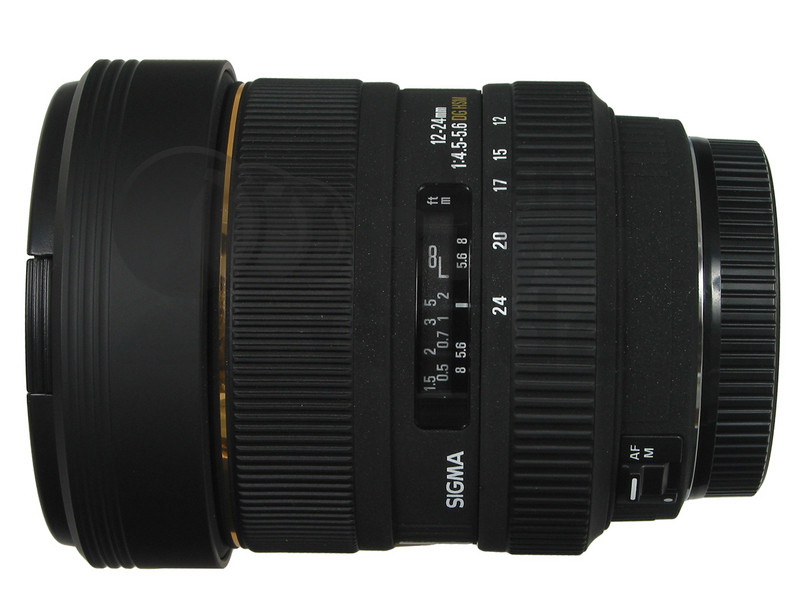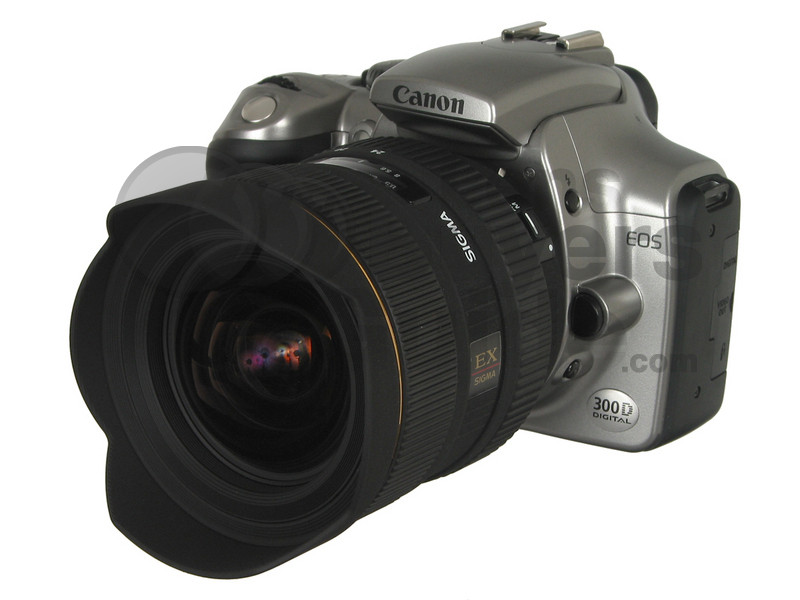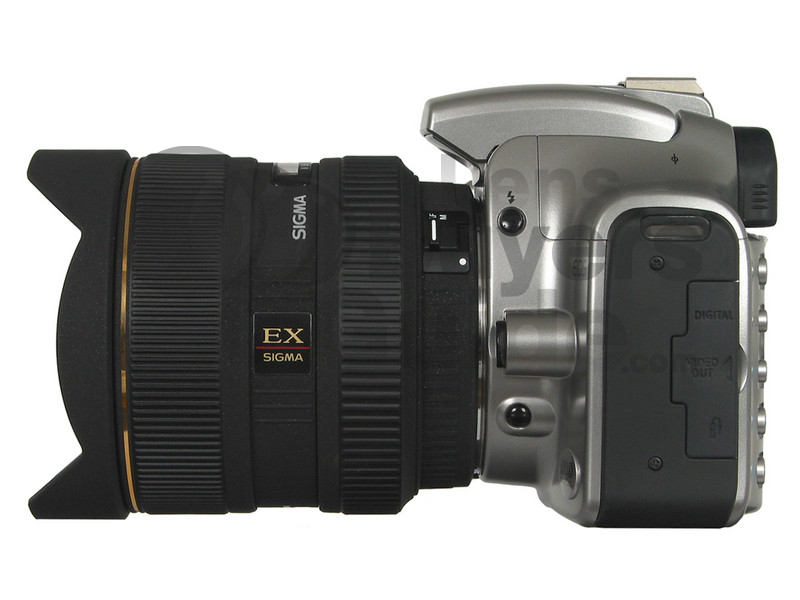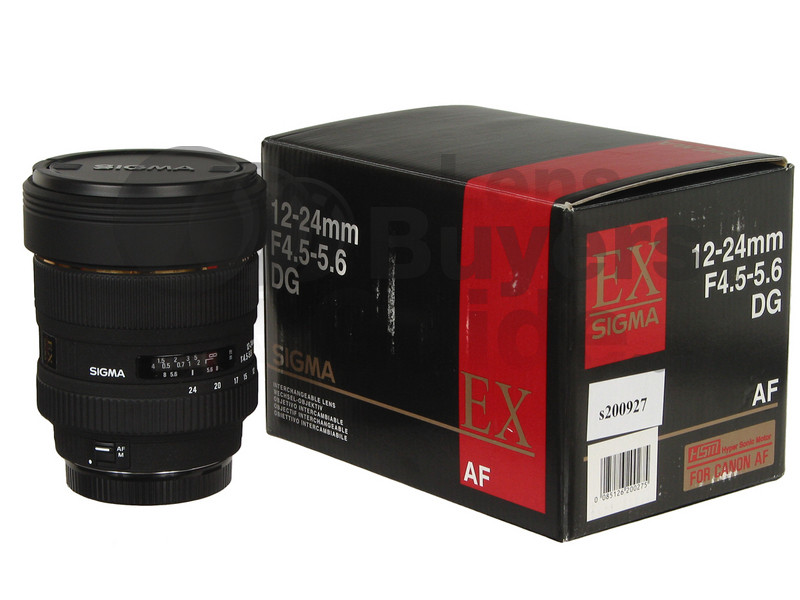
全影像大小可產生APS-C大小影像的鏡頭只屬數碼屬性,它們不可使用於比APS-C 格式更大的影像接收器,也不適用於菲林相機。 超聲波自動對焦一般來說,超聲波對焦鏡頭比傳統對焦鏡頭靜和快。 使用了一個或更多的低散光度鏡頭元素低散光度鏡頭元素能減低彩色的色差。 不穩定影像穩定器能減低手震時產生的模糊影像,特別在長焦距或陰暗情況下。根據倒數的定律,影像穩定化比無影像穩定鏡頭能有1到3個光圈優點。 金屬接腳平價鏡頭通常會使用塑膠接腳,而較昂貴的專業的鏡頭會使用金屬接腳。一般來說,金屬接腳會比較耐用的及當鏡頭改變很多。當相機主要使用一個鏡頭,接腳物料並不是很重要。 內置對焦內置對焦鏡頭不會因設定焦點而改變其大小。 固定前鏡頭固定前鏡頭在變焦及/或對焦時不會轉動,故可容許攝影師用花瓣狀遮光罩,固定前鏡頭能更容易利用極化濾鏡。 支援插入濾鏡插入濾鏡使用於那些前鏡頭過大或視野不容許於鏡頭前傳統濾鏡的鏡頭。通常遠攝及超廣角鏡頭支援這類濾鏡。 |
|
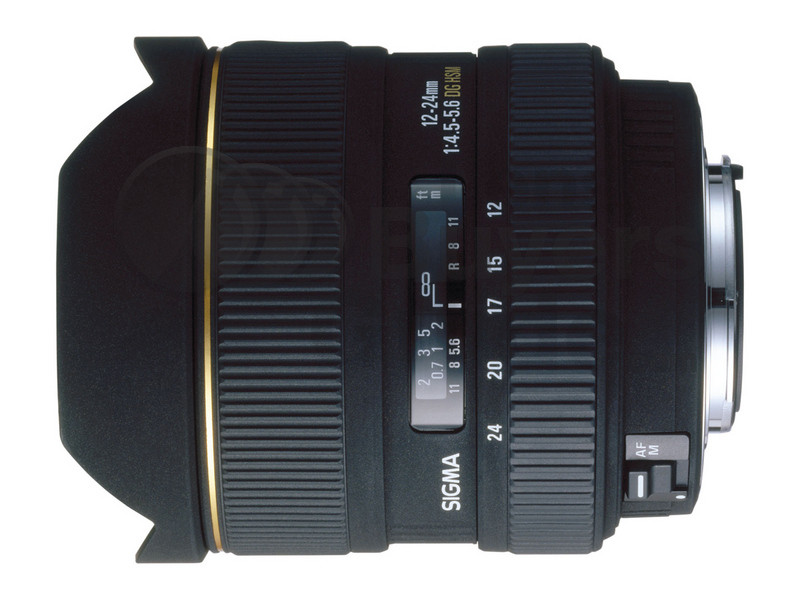
| 可用的接環 | Canon EF, Nikon F, Pentax K, Sony / Minolta A, Sigma |
| 應用 | 風景, 室內, 建築物 |
| 類目 | 廣角變焦 |
| 倍增器 | 1× |
| 穩定器 | 否 |
| 焦距 | 12 - 24 mm (2× 變焦) |
| 鏡片組 | 12 群組含有16 元素 |
| 視角 |
35毫米: 122-84.1° 數碼: 93.1-54.8° |
| 葉片數目 | 6 |
| 最大光圈 | 廣角: f/4.5 遠攝: f/5.6 |
| 最小光圈 | 廣角: f/22 遠攝: 不適用 |
| 最短焦距 | 28 cm |
| 放大 | 0.14× |
| 濾鏡大小 | 不適用 |
| 大小 | ∅ 87 × 102.5 mm |
| 重量 | 600 g |
| 記錄 |
|
| 自動對焦速度 | 不適用 |
| 自動對焦聲音 | |
| 內置對焦 | 是 |
| 內置變焦 | 不適用 |
| 固定前鏡頭 | 是 |
| 接駁類型 | 鐵 |
| 天氣密封 | 不適用 |
| 插入濾鏡 | 是 |
| 超聲波自動對焦 | 是 |
| APS-C大小的圈 | 否 |
| 低散光度鏡頭元素 | 是 |
| 硬機殼 | 不適用 |
| 軟機殼 | 不適用 |
| 遮光罩 | 不適用 |
| 三腳架接合器 | 不適用 |
3 July 2006
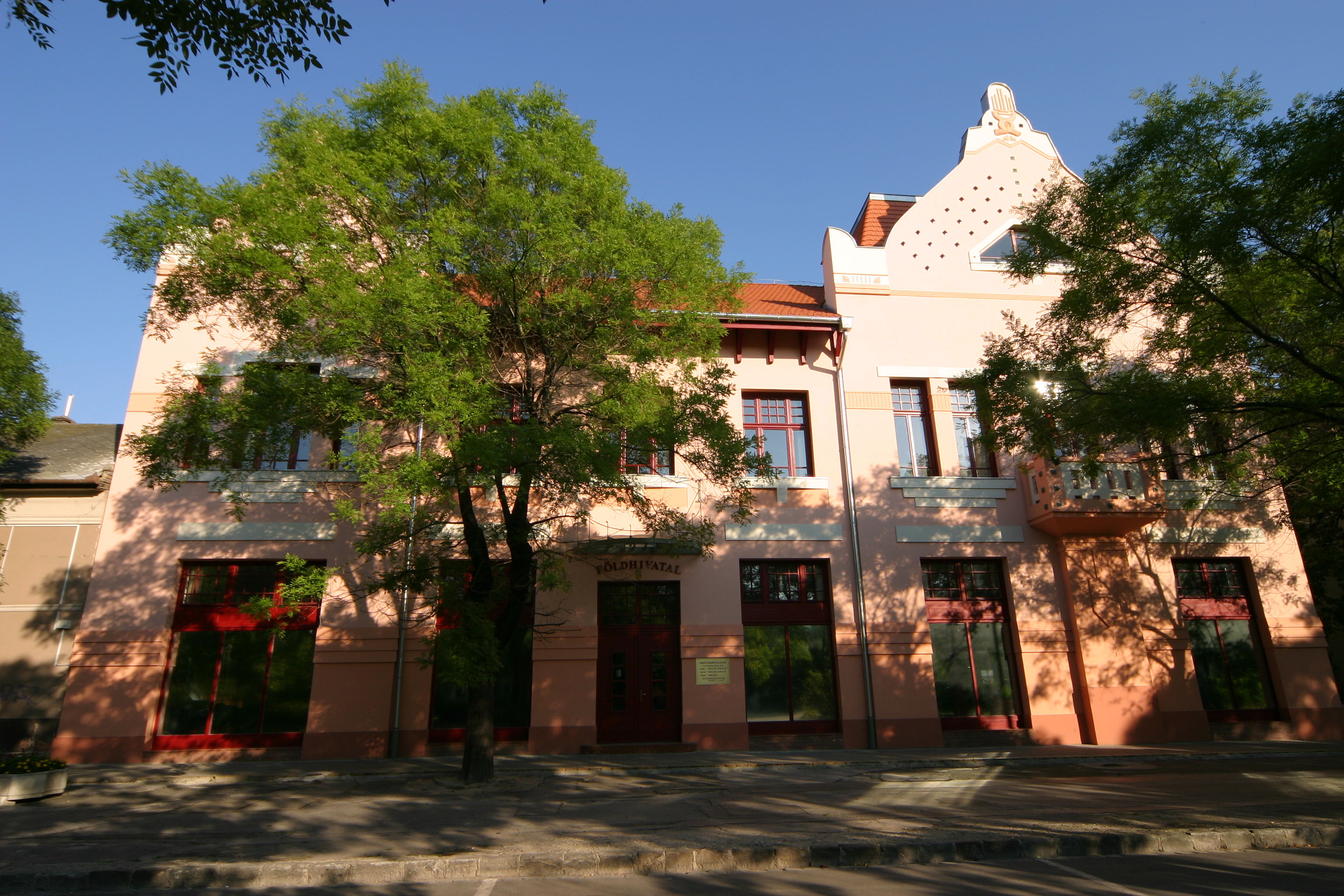
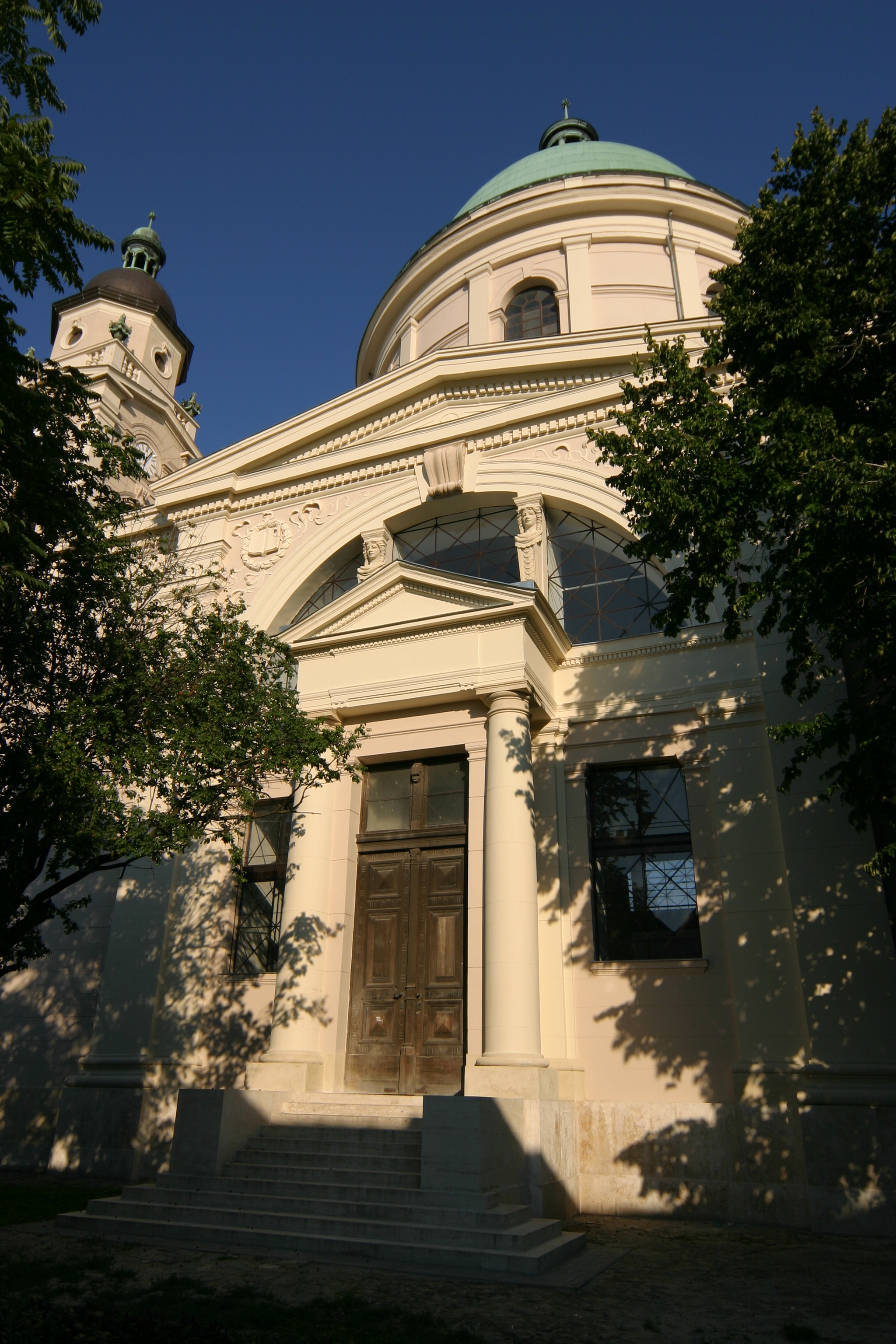
There's nothing else this wide for use on a full-frame 35mm camera or digital such as the Canon 5D. It's so wide on a full-frame that you can almost see behind you (well not quite, but close to 180 degree field of view). It is not a fisheye, so straight lines stay straight. There is some minor vignetting at 12mm but less than the Canon 17-40 L-lens I had at 17mm. This lens is pushing the limits of physics so it is not as sharp as some lenses but it takes in so much more of the view and provides a crisp image all the way to the corners.
For use on a cropped sensor camera, such as the XT, 20D or 30D a better choice may be the Canon 10-22mm which is uber-sharp in the middle of the frame. The Canon, however, gives fuzzy images on the sides when wide open but sharpens up when stopped down to f8 or more. My third copy of the Sigma lens is less sharp than the Canon in the center of the frame but is sharper starting about halfway to the edge when both lenses are wide open. Near the edges of the frame the Canon gives a dark and mushy image when wide open at 12mm while the Sigma is only slightly less sharp than at the center - truly amazing!
Unfortunately, Sigma lenses are seemingly sold "as-is" with wide sample variations. The autofocus died on my first copy of the lens after less than 30 pictures. The second copy had poor optics with soft and fuzzy pictures even when manually focused. The third copy is sharp at 12mm, even wide open, all the way to the edges, but only if manually focused. At 12mm the lens autofocuses too far away when an object is close and too close for distant objects. At 24mm it autofocuses right on but is softer than at 12mm. I've decided to keep it since it is easy to manually focus. The depth of focus is large at 12mm. For objects further than a few meters away when using 12mm just set the lens to infinity and everything from a few feet to infinity is in focus even at the edges of the frame and in the corners. The lens has a 4-year warranty so I may send it in to Sigma for calibration later.
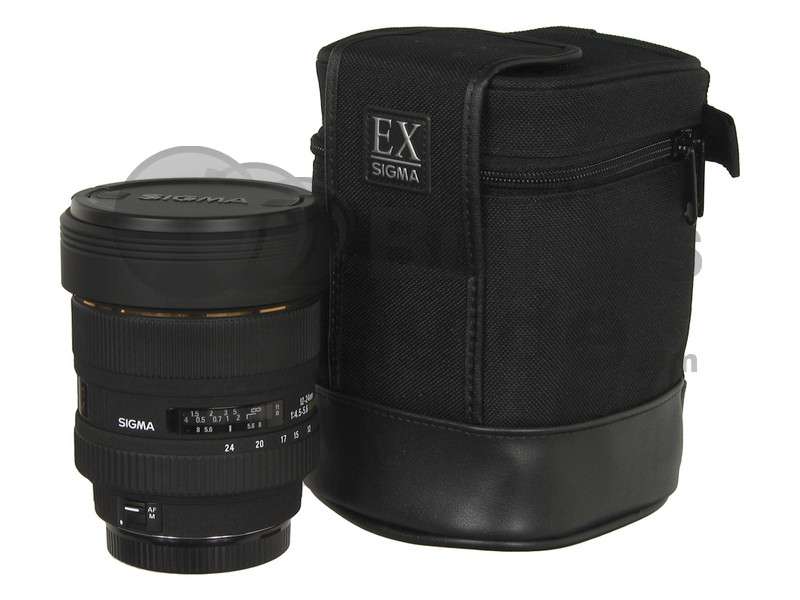
Pros: (1) Unique ultra-wide angle perspective on a full-frame camera. (2) A good copy will be optically sharp all the way across a full frame, even wide open. Further, there's virtually no purple chromatic aberation near the edges of dark objects with bright backgrounds. (3) Nice build quality with good finish and large smooth focus ring. (4) Straight lines stay straight so no defishing needed (defishing uses interpolation which lowers resolution away from the center). (5) Lens comes with a case and has a small built-in hood (serves mainly to protect the front element). (6) 4-year USA warranty if purchased from an authorized dealer like Amazon or B&H. Otherwise you get a 1-year International Warranty.
Cons: (1) Wide sample variation - getting a good copy takes luck or persistence while trying multiple copies. (2) The bulbous front element (this lens is nicknamed "Popeye") is exposed and no standard filter can be used for protection so be very careful. (3) Flares easily. The sun does not need to be in the picture just anywhere not behind you. This is a result of the ultra-wide design and not a fault of Sigma. (4) Photos sometimes come out too bright, giving the appearance of low contrast. Photoshop or other software easily fixes.
22 January 2006
I use this lens primarily for architectural work. It's rugged, fast focusing, and most important, distortion free (i.e., straight lines stay straight). Dramatic design, built for full frame use if (when) you decide it's time to go that way. It's also performed extremely well for landscapes....even some shots at weddings. My most frequently used lens. (Hint: on the APS-C format digital SLRS, you can leave the accessory ring on the lens - it provides additional flare resistance, and there is no vignetting.)
13 January 2006
I am a pretty serious amatuer photographer and I keep coming back to this lens. It's really well made lens and its survived much mistreatment without a problem. You're going to get lens flare problems that you won't get with a canon 16-35, but in tests I've done, its sharper at the edges than the 16.
If you take alot of landscape shots or are on vacation taking shots of landmarks and such, you'll love this lens.
8 August 2006
I ordered this lens because I wanted the widest angle without getting a cropped lens (the Canon 10-22). I have had great luck with Tamron 3rd party lenses and the price was great so I thought what could be better? I should have paid more attention to what everyone else said about quality control. On the good side the wide angle is truely fantastic (can't wait to see the 10-22). Also the color responce, saturation, and contrast are absolutely stunning. Comes out right with no post production needed. Unfortunatly the good ends there. As far as sharpness, clarity, and focusing the camera is simply not usable. It is simply the worst quality lens I have eveer used. Even manually focused, stopped down, high shutter speeds, and clear skys this lens is so blurry and fuzzy you think you took it with a cheap camera phone. Not to even start about the chromatic ab., noise, and fringing. None of my images were usable at all. I decided that wasn't worth the price and I didn't want to deal with sending it back to Sigma 2-3 times like others had when I could get a Canon 10-22 for a bit more and know I will get good quality. Don't get this lense, it isn't worth the money. (If you are using a full frame camera like the 5D then it would be a shame to put such a bad lens on it. Get the Canon 10-22. Not to mention the Sigma really is huge with rather poor quality construction. The zoom and focusing ring were also almost impossible to use.
21 July 2008
I bought this lens to service a new client that does virtual tours for hotels and resorts. Their lens requirements are 18mm for full frame digital cameras and 12mm for DX chip cameras, to shoot 360 degree VRs. I didn't want to invest the 1000.00 plus dollars for another Canon lens and Canon or anyone else for that matter doesn't make a lens with this range. The Sigma would allow me to use both my 1Ds Mk II and 20D to service this client and cost me half what anything Canon provides.
Having bought the lens mainly for Internet content, I wasn't going to be too critical about image quality from it, but I've been very surpised and pleased by it's performance. This lens has the least amount of barrel distortion of any wide angle zoom lens I've ever used. Even less than some primary lenses. To the point where it is essentally undetectable to the naked eye. It has less barrel distortion than my 1000.00+ 24-70mm f2.8L Canon lens! Operation is smooth, fast and constructions is first rate. I haven't done any critical sharpness comparisons yet, but I haven't noticed any problems from the images I've taken so far.
The lens has a very bulbous front element, so conventional filters and lens caps won't fit. But Sigma cleverly includes a high quality adapter ring with filter threads in one end that slides over the built in lens shade on the lens. A lens cap is also included that fits on the end of the ring to protect the front element while being stored. The ring vignettes at 12mm on a full frame camera, but does not on DX chip cameras. So on those cameras, conventional thread on filters can be used with by screwing them on to the end of the adapter ring. You could do also this on full frame cameras, at longer focal lengths. A gelatin filter holder is provided on the back of the lens, but I can only imagine this being useful with film cameras.
Overall, I'm very impressed and satisfied with this lens. I highly recommend it.
8 May 2007
The Sigma 12-24 is an excellent ultrawide. It is very sharp with very little barrel or pincushion distortion. It is a true 12-24 fullframe with a film SLR (love it with my Nikon N80) or full frame digital slr, and effectively an 18-36 with an APS-sized sensor digital SLR. Excelleent ultrawide for architecture, landscapes etc. At 12mm though, it is so wide that you must be careful of distortion introduced by shooting off-level. This is not to say this particular lens is faulty and distorts, but would be true of any ultrawide lens with this wide degree of coverage. While I have heard much talk of supposed poor Sigma quality control, I have no qualms at all about this lens - It is sturdy, tough, smooth and has performed flawlessly for me for years.
23 December 2007
Sigma has been much maligned by the Nikon-brand lens snobs, and not without good reason. The build quality and optical clarity of the average Nikon lens easily trounces the average Sigma.
This particular Sigma lens has been in my bag since 2004 (three years now) and has performed flawlessly in dusty, humid, and rainy conditions. I can't say that about every Nikon lens I have owned.
Don't get me wrong-- this is not a flawless lens. It is weather sealed enough, but I doubt it would survive being dunked in water the way some (but not many) Nikon lenses would. It focuses faster than many Nikon lenses, but slower than competing Silent Wave Motor Nikons. It is quieter than any non-SWM Nikons, and almost as quiet as SWM. It focuses as well as any Nikon f/4.5-5.6 lens in similar lighting conditions.
Now for the flaws. It has more chromatic aberration than Nikon's 12-24mm DX and 14-24mm FX lenses. It isn't as sharp, especially near the edges. But if your maximum print size is 8x10 you'll likely never notice.
UPSIDES: Even though it works at full frame (important for those of us that still shoot film as well as digital) it is much cheaper than Nikons 12-24 f/4.5-5.6 DX lens-- a lens that is only good for DX-sized sensor digital Nikons. It is less than 1/3 the price of the recently released FX (full-frame) 14-24mm f/2.8 Nikon lens.
Granted, the professional Nikon 14-24mm lens is clearly the best of the bunch, but most of us can't afford that extravagance. When I bought this lens it was the only 12-24mm lens available, and given the offerings from Nikon and other third-party lens makers, I can't regret this purchase for one moment.
While I'd like to own the new professional Nikon 14-28mm f/2.8 lens, that won't be in my budget in the foreseeable future. My buying advice: take your camera to a good local camera shop and try this lens (and its competitors) for yourself. I'm confident many of you will agree that the Sigma, while it is not the best lens, is good enough and the best compromise-- given the price.
Cheers.
18 July 2006
I got it because I intend to use it on both my film and my digital bodies. For ultra wide angles I'll use it with film (Nikon N-80) and for more conventional wide angle with my Nikon D-200. It's one of three lenses I'm taking with me on vacation to the mountain states. The others are a Nikkor 28mm - 85mm and a Nikkor 70mm - 300mm with 2X Tamron SP doubler. Since I don't yet have photoshop or similar I wanted to be able to take real wide shots without having to paste them together.
24 March 2008
I've been using this lens for about 3 years now and wanted to upgrade so I read all good things about Tokina (since I could not afford the Nikon). I purchased the 12-24mm Tokina and returned it because of horrendous camera flare which the Sigma does not have. Granted there is "some" flare issues with most wide angle lenses but the Tokina was totally unacceptable. I didn't see any major differences in picture quality either. Both lenses must be used at F/8 for the best sharpness. I am keeping the Sigma and buying a Nikon D300 instead.
10 March 2008
I have had this 12-24 wide zoom for a while now and my opinion of this lens is improved. It is growing on me. The review I wrote below is true enough, but it is pretty understated. I must say I'd give this lensanother star after using it for a while. You could invest in the Pentax 14 mm and 21 mm wide primes and the 16-45mm Pentax Lens to try to cover this range with something optically superior, and that might improve on the images you can get some of the time. You would lose the convenience of the zoom below 16 mm and you would give up the range below 14mm entirely. You'd gain a stop in light gathering ability for sure, but you'd need to be a juggler and you'd need wheels on your camera bag to haul it all around. I am finding this almost fisheye zoom range is addictive, I get the shots I need with this. They are everything they need to be to use in the marketing materials that most of my images are destined for.
Original review:
I was torn between the Sigma and the Pentax zooms at this focal range. they both seemed to offer to adequately provide the wide angle range that I needed to do the everyday shooting of building interiors and exteriors. Both were wide enough and seemed optically good enough. The test images I saw seemed like they might be sharp enough, and they were surprisingly free of spherical distortions for lenses that wide. Both lenses were reported to be prone to some bad optical flare effects from direct sun on the lens. It's all true for the Sigma at least. It could be sharper. It is, however, good enough if you're using your shot nearly full frame. If you're needing to crop much of the image the sharpness may not be there to get a good large print. the Sigma was about a hundred bucks under the price of the Pentax so I went for it. I have nothing to go on to compare the Sigma to the Pentax 12-24 zooms, except the sample images posted on Amazon and in other reviews on line seemed on close reading to favor the Sigma. I think they both are nothing to write home about in the sharpness department when you zoom way in. But they are still darned wide zooms and reasonably free of spherical distortion for a lens that wide. I'm getting good enough images and prints to use at 8X10, (without photo shopping any distortion out) provided I'm careful to frame the shot close to the way I want to print it.
28 May 2008
This is the first ultra wide angle I've owned and now I wonder what I ever did without it. It's sharp and quick to focus. The build is of excellent quality. It never leaves my camera bag.