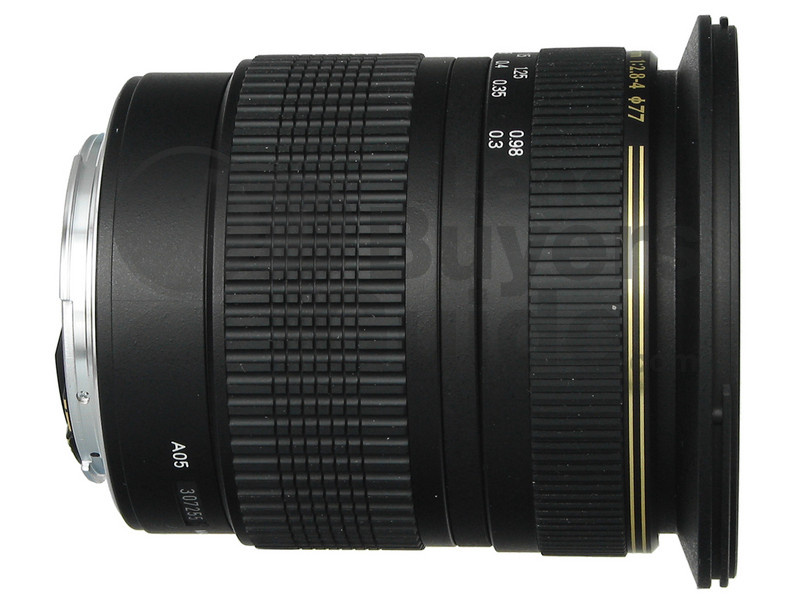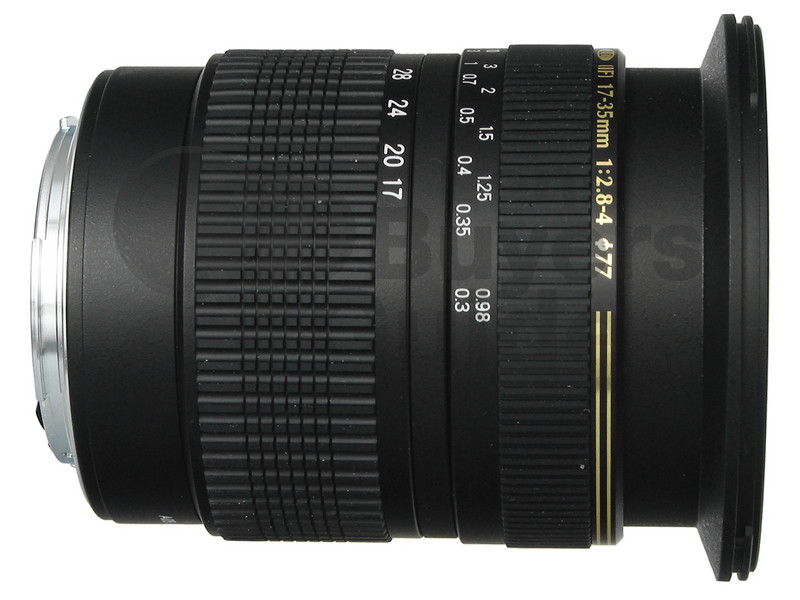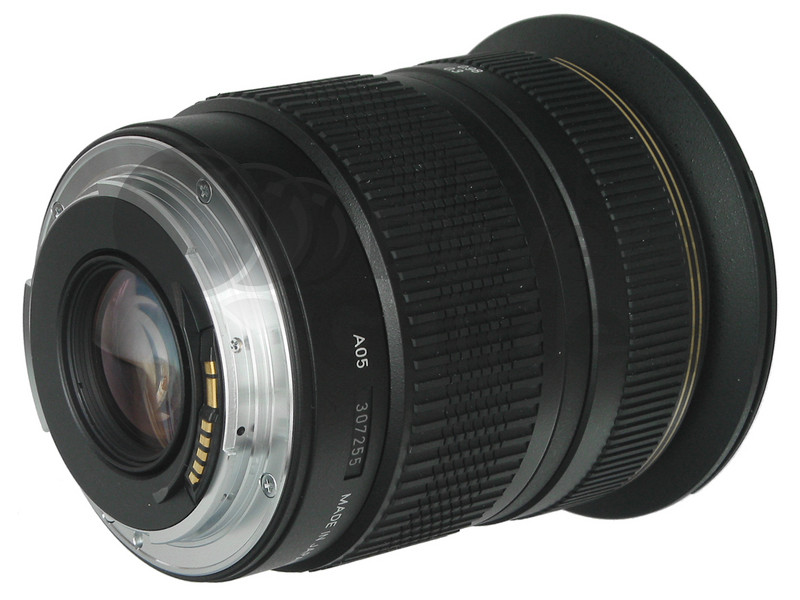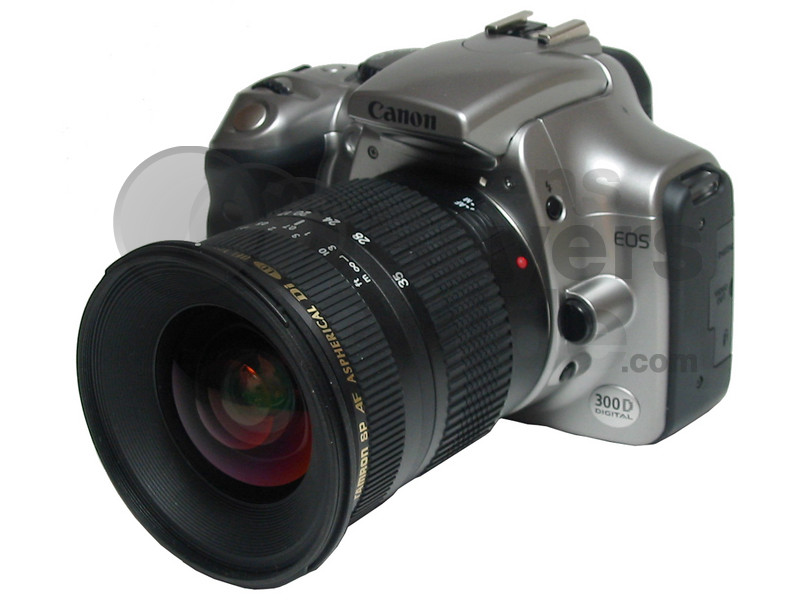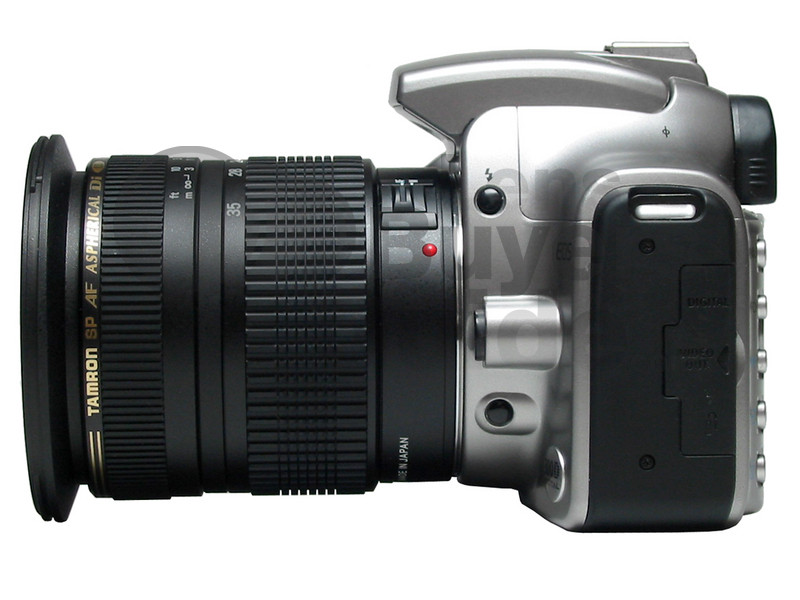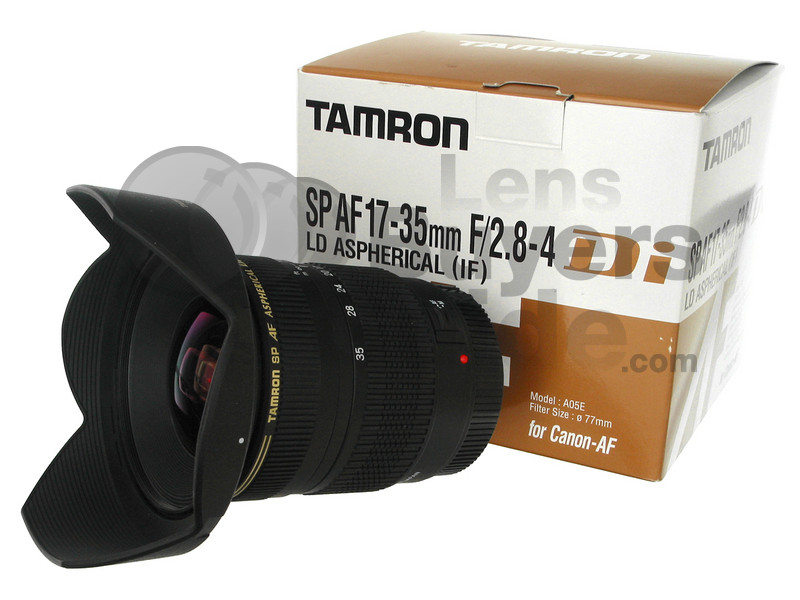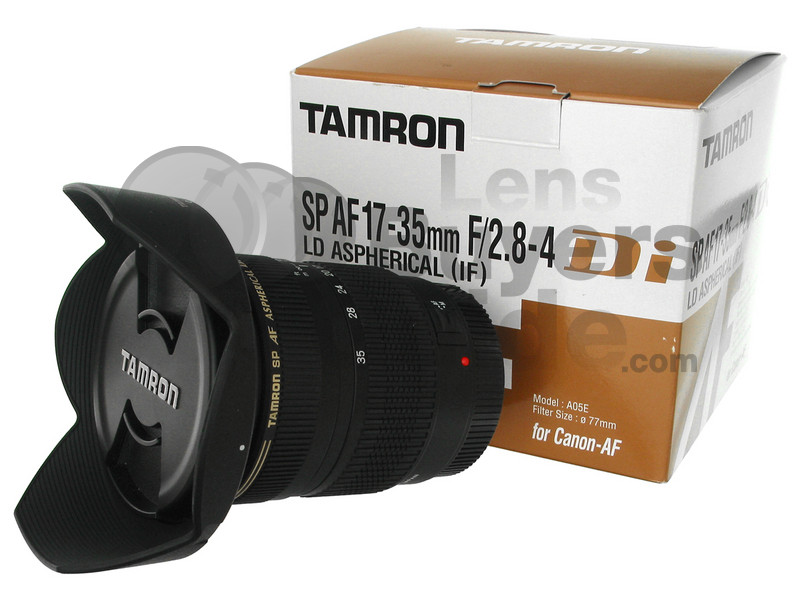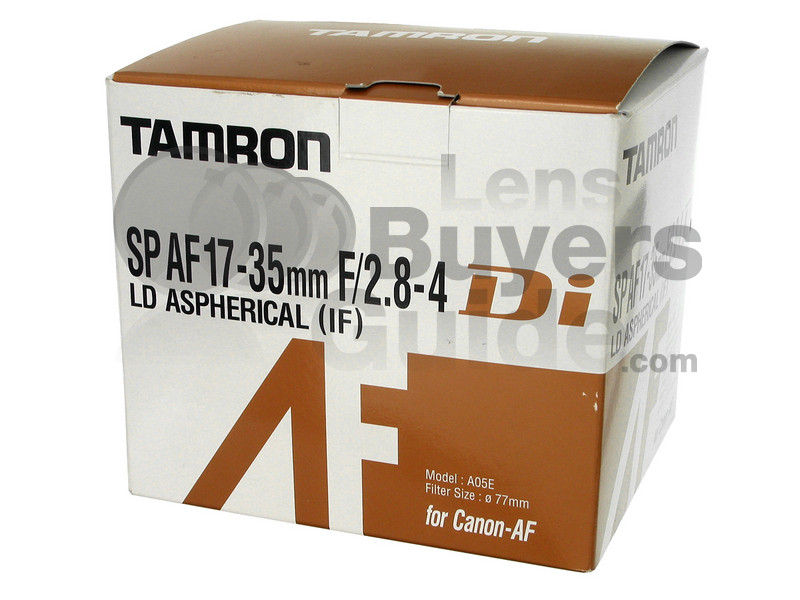
全影像大小可產生APS-C大小影像的鏡頭只屬數碼屬性,它們不可使用於比APS-C 格式更大的影像接收器,也不適用於菲林相機。 無超聲波自動對焦一般來說,超聲波對焦鏡頭比傳統對焦鏡頭靜和快。 使用了一個或更多的低散光度鏡頭元素低散光度鏡頭元素能減低彩色的色差。 不穩定影像穩定器能減低手震時產生的模糊影像,特別在長焦距或陰暗情況下。根據倒數的定律,影像穩定化比無影像穩定鏡頭能有1到3個光圈優點。 金屬接腳平價鏡頭通常會使用塑膠接腳,而較昂貴的專業的鏡頭會使用金屬接腳。一般來說,金屬接腳會比較耐用的及當鏡頭改變很多。當相機主要使用一個鏡頭,接腳物料並不是很重要。 內置對焦內置對焦鏡頭不會因設定焦點而改變其大小。 固定前鏡頭固定前鏡頭在變焦及/或對焦時不會轉動,故可容許攝影師用花瓣狀遮光罩,固定前鏡頭能更容易利用極化濾鏡。 無插入濾鏡支援插入濾鏡使用於那些前鏡頭過大或視野不容許於鏡頭前傳統濾鏡的鏡頭。通常遠攝及超廣角鏡頭支援這類濾鏡。 |
|
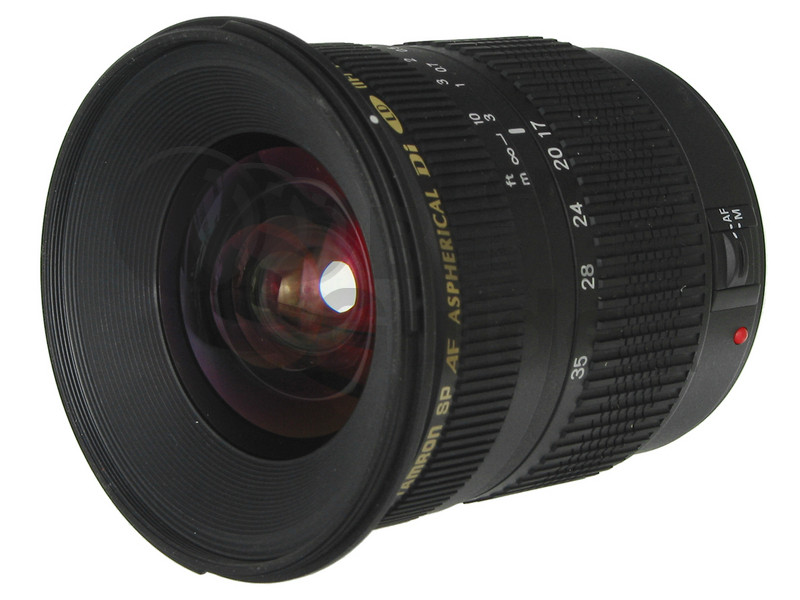
| 可用的接環 | Canon EF, Nikon F, Pentax K, Sony / Minolta A |
| 應用 | 風景, 室內, 建築物 |
| 類目 | 廣角變焦 |
| 倍增器 | 1× |
| 穩定器 | 否 |
| 焦距 | 17 - 35 mm (2.1× 變焦) |
| 鏡片組 | 11 群組含有14 元素 |
| 視角 |
35毫米: 104-63° 數碼: 不適用 |
| 葉片數目 | 7 |
| 最大光圈 | 廣角: f/2.8 遠攝: f/4 |
| 最小光圈 | 廣角: f/22 遠攝: f/32 |
| 最短焦距 | 30 cm |
| 放大 | 0.19× |
| 濾鏡大小 | 77 mm |
| 大小 | ∅ 83.2 × 86.5 mm |
| 重量 | 440 g |
| 記錄 |
|
| 自動對焦速度 | 不適用 |
| 自動對焦聲音 | |
| 內置對焦 | 是 |
| 內置變焦 | 不適用 |
| 固定前鏡頭 | 是 |
| 接駁類型 | 鐵 |
| 天氣密封 | 不適用 |
| 插入濾鏡 | 否 |
| 超聲波自動對焦 | 否 |
| APS-C大小的圈 | 否 |
| 低散光度鏡頭元素 | 是 |
| 硬機殼 | 不適用 |
| 軟機殼 | 不適用 |
| 遮光罩 |
包含 可印刷的遮光罩 |
| 三腳架接合器 | 不適用 |
5 October 2006
I ordered this lens as the wide end adjunct to my f2.8 lenses (100, 135, 28 -70 & 70-200mm). I am anticipating a full-frame in the future and I still have a couple of very nice 35mm cameras so I passed on the Tamron digital only 17-50 f2.8. I was extremely pleased with my first "real world" low light test of this lens. You see I shoot billiards (pool) competitiions which is low artificial light and absolutely no FLASH. This lens handled the challenge with swift Auto Focus and sharp contrasty images. The minimum focus distance is amazing and an unexpect bonus. This lens has gotten me to wonder if the Tamron 28-75 f2.8 is equal or better than. So, I am looking to find out. It couldn't hurt having two great lenses in that range?
I hope this is helpful. I know it isn't a technical review so to speak. I judge things on the real world results I get and if they live up to my expectations of "the shot" - and this did. That is why I would recommend it to anyone looking for a lens that will provide wide end speed/low light capability with the flexibility to go full-frame (and ultra wide) if needed. Happy hunting!
14 December 2006
I've read in many articles about how amateurs blow thier budget for lenses on two or more instead of blowing on a solid lens. I took the advice to buy the best that I can afford for one, an I'm truly delighted. This lens is a step up from the kit lens you would get with the K100/110/10d's, and performs much better.
Pros:
-- Max aperture of 2.8 is nice to get more focused on your subject, and for lower light situations. Most kit lenses have a max of 3.5 or more.
-- Good for moderate wide angle shots.
Cons:
-- It's a bit heavier then the kit lenses.
7 February 2005
If you have read my review for the Canon i9900 you know that I shoot for Federal Law Enforcement and the military, with them I shoot prime OEM lens not third party lens...
However I cannot personally afford OEM lens so I shoot third party, this Tamron lens is by far the best third party lens I have ever used. It is built very sturdy, not flimsy feeling as third party lenses can feel. It is very sharp, and the outer frame distortion is very low. The Bokeh(circles of confusion) are very nice as well. I think this is worhty in anyones camera bag!
Dennis
23 January 2006
On a 1.6x crop factor camera like the Canon 350D/20D, the effective area of this lens is equivalent to a 27-56mm lens on a old school film-based SLR camera. As I come from a background of extensive 50mm lens use, I find this to be my most common working range (and I have four other excellent lenses in my bag to choose from).
My reason for purchase was to replace the pathetic kit lens that comes with the 350D. The Tamron is a much faster lens at f/2.8-4, and as it is designed for full-frame SLR use, the photos you'll get on a 1.6x crop factor camera are outstanding. The edges are sharp and just as bright as the center. In fact, the images produced with this lens are so sharp that you'll find yourself reducing the in-camera sharpening for portraiture. Additionally, my photos show great contrast and need very little--if any--post processing.
I do have a few complaints about this lens. First, the lens hood's diameter is enormous (over 4"), and I wish there were a smaller hood for 1.6x crop factor camera use. Second, like all Tamron lenses that I have encountered, the manual focus ring moves during autofocus. Third, the focus should be faster and much quieter. However, in light of all the positive aspects going for this lens these are minor issues.
Reviewers on other websites have given this lens outstanding marks, and it was only after careful research that I decided on purchasing it. I was then off to Thailand where this lens truly proved its worth.
6 October 2005
I bought the Tamron 17-35 for my Canon 20D, to compliment the Tamron 28-75 XR DI which I liked a lot.
The 17-35 range is definitely wide angle, and not much use beyond that. The lens is great for indoors shooting, and outdoor shots where you want to get in close with your subject or your looking for some wide panoramas.
Right out of the box, I started taking shots that seem reminiscent of some National Geographic indoor/people shots. Tthis lens will give you shots and a perspective that only professionals have the luxury of.
The lens is definitely sharp with good contrast. It's nice to have F2.8 at 17mm. Very interesting to watch the max aperture change to F4 in what seems to be a fairly short zoom range.
The lens surface is somewhat bulbous and almost sticks out as far as the edge of the lens, which makes me wonder if it will be easy to get scratched. Somehow a UV filter doesn't seem like the answer.
I haven't had a problem with flare but then I know how to steer backlit shots.
Build quality is very good, up to the usual Tamron high standards.
For some reason I rated the lens at 4 stars, whereas I rated the Tamron 28-75 at 5 stars (see my other reviews).
I'm not sure why I rated the lens lower than the 28-75, but maybe it just speaks to the usefulness of the lens.
The 17-35 is not the lens your likely to have attached to your camera most of the time. Certainly a 28-75 is more practical.
But, for the price, it is definitely a lens that can have its applications, and separate some of your shots from the rest of the crowd.
I would recommend this lens as a wide angle, for sure. Given the price and build quality, its a very good value.
5 January 2006
This is about the same range of the Canon 17-40mm F/4L lens and offer equivalent and sometimes superior optical quality and it's F/2.8 at the wide end. The lens is super sharp and very contrasty, with fast auto-focusing and a good feel on the focusing ring. The best part is this fast and optical superb lens is about half of price of the Canon 17-40mm lens. A true steal. Can't say enough good things about it. I am posting some sample pictures to show how good the image quality is, too bad the image size can't be bigger because the sharpness from this lens is truly amazing.
13 February 2007
Wide angle lenses have got to be the love-hate lens in any high end camera collection. You are always giving up something. Zooms especially engender frustration as they are least able to tease away the annoying reality of wide angle problems.
Except in a very high end models, the sensors don't see the full 1:1 range, so any lens tends to be somewhat telephoto (zoomed in). So now a wide angle lens , zoomed in a bit by that geometry, may stand in to serve as a more standard viewing lens to offset that inherent zoom (from the digital sensor). In that case, variable zooming sure would be nice to have - but not if wide angle optical problems come with it.
So go totally broke (a lens over $1500) or put up with some form of nasty edge lighting problems, distortion, color shift etc. One brand of wide angle - a well known brand - has a great potential version with great sounding specs, but gets it right on maybe half (huge problem with bad manufacture). Nope. Crap shoot.
This brand's version, Tamron, is rock solid, inexpensive for the level of image quality, and can serve as the default lens to leave on your digital SLR. It's that good. Whatever they did to make this lens, you are not aware of seeing "wide angleness" when viewing the images.
And yes you could go wider in angle with other choices, maybe buy the Russian fisheye for really extreme purposes. That's not an alternative for this lens, especially on a 1.6 conversion as with most digital backs. The one reviewed here, got a good work out on a Canon Rebel, given as a gift to a professional photographer whose images with it are just wonderful.
Now I want one for me.
3 February 2007
For film cameras, 17-35mm has become the most versatile "very wide angle" zoom range. With digital bodies this focal range translates to ca. 25-52mm, what makes this lens a "wide to standard" zoom. Because the lens is calculated for full 35mm size frame, vignetting is not a problem. Most of full frame lenses are in their best sugar spot, when used on DX sized digital sensors, and this Tamron is not an exception.
The lens is not f2.8 in its entire range, but seemingly Tamron chose to design it this way as a compromise toward making it small and light. Compare this lens to the Nikkor 17-35 f2.8 AFS, both in terms of weight, and also in terms of its very attractive price. Of course, for some users all this plastic is just "too cheap" and is not an acceptable option. Personally I vote rather for less grams/pounds, if optical valors are comparable.
The lens seems to be quite sharp, and tests confirm its excellent resolution. Mine has only very little distortions, however I saw exemplars of this lens exhibiting visibly more barrel distortions! Probably the manufacturing tolerances are not tight enough...
Front element does not rotate with focusing, but the focusing ring rotates and thus the lens does not support the automatic AF/MF overwrite, like in a AFS Nikkor or in a usual Canon EF lens.
The hood is a total loss. It simply reflects too much light on its internal side. Tamron should really coat their hoods for better light absorption, like others do! Fortunately, this lens seem to control flare quite well. I tend to shade the lens with a hand anyway.
Considering the very attractive price, resolution and weight, this is a good product, great value for the money. If you do not like plastic like that, consider than the need to spend $1200 for the genuine Nikkor alternative, and maybe than the plastic will not appear that bad after all.
My generic problem with all Di XP Tamron lenses is however their lack of good grip to perform quick lens exchange. When changing this lens, you will end up turning both focusing and zooming rings to some degree, sometimes to a lot of degree... I wish that Tamron would have made the both rings a bit shorter, and provided good grip in the middle to turn the lens reliably into and out of the mount.
27 February 2007
I bought this lens for use indoors at family gatherings and for scenery. I knew this was a fast lens (f/2.8) but was surprised at the physical size of it. I was also amazed at the filter size it required as well. Anyway, I gave the lens to my son (we both shoot with Nikon D50s) and he LOVES this lens. He has taken hundreds of images with it and the ones I have seen are GREAT. Sharp and clear. I should mention that I went with the Sigma 18-50mm because it was physically smaller, utilizes the 58mm filter size available in my camera bag, and cost about $200 less.
24 October 2008
I live in the Peruvian Amazon jungle and bought this lens about a year ago thinking it would be just the ticket to capture the vast expansiveness of my surroundings without having to lug about a heavier and sturdier lens with about the same focal length options. Not 8 months later, even though I'd treated the lens with all the respect it deserved, it became contaminated with fungus and could no longer be used. I took it to my German camera maker in Los Angeles when I returned there last month who, after attempting to disassemble same, pronounced it "Kaput" as, because the lens groups are spot-tack-welded, they cannot be separated and cleaned, thus rendering the lens quite useless. Nothing of value could be salvaged from it so I chucked it in the bin. I suggest you buy a metal or carbon fibre lens instead...anything but this plastic job which cannot be repaired when trouble with the lens groups arrives.
4 January 2007
This lens is so much fun and it's really fast too.
21 October 2007
Bought this lens from Amazon for a 35mm film SLR (Canon EOS 7NE) and it is
the best lens I had so far.
Color & sharpness are unbelievable!
The only drawback is a very minor barrel distortion.