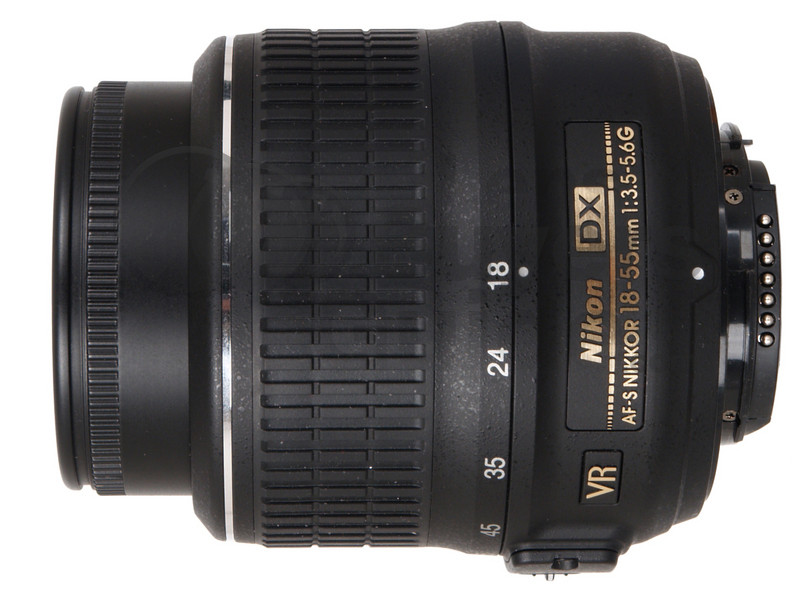
APS-C sized imageLenses that create APS-C sized image are designed for digital only. They cannot be used on cameras that have image sensor larger than the APS-C format. These lenses are not suitable for film cameras either. Ultrasonic AFLenses with ultrasonic focusing mechanism tend to be quiter and faster than traditionally focusing lenses. No Low Dispersion lens element is usedLow Dispersion lens elements help to reduce chromatic aberration. Built-in image stabilizerImage stabilization helps to reduce blur caused by hand shake, especially at high focal length or in low light situations. Image stabilization can give 1 to 3 stop advantage over none stabilized lens, based on the reciprocal rule. Plastic mountCheaper lenses are usually equipped with plastic mount, while more expensive, professional lenses have metal mount. In general, metal mounts are more durable, and a good thing to have when lenses are changed a lot. When a camera is used mainly with one lens, the material of the lens mount is not that important. No Internal FocusingInternally focusing lenses don't change their size while setting focus. No Internal ZoomInternally zooming lenses don't change their size while focal length is changing. The front lens is rotatingThe fixed front lens is not rotating during zoom and/or focusing. This allows the photographer to use petal shaped lens hood. Fixed front lenses also make the use of polarization filters a lot easier. Not SealedWeather sealed lenses are protected from dust and water. While they are not water proof, these lenses can be used in rain and other humid environments. Some sealings only provide protection against dust or water, not both. Sealing is only available when the lens is used on a similarly weather sealed camera body. No drop-in filter supportDrop-in filters are used in those lenses where either the front lens is too large, or the field of view doesn't permit the use of traditional filters at the front of the lens. Usually bright tele and ultra-wide angle lenses support this filter type. |
|
| Available mount(s) | Nikon F |
| Application(s) | Portrait, Closeup, Landscape, Architecture |
| Category(s) | Standard zoom |
| Multiplier | 1.5× |
| Stabilizer | yes (3 f-stop advantage) |
| Focal length | 18 - 55 mm (3.1× zoom) |
| Lens construction | 7 elements in 5 groups |
| Angle of view |
35mm: N/A digital: 76-28.17° |
| Number of blades | 7 |
| Maximum aperture | wide: f/3.5 tele: f/5.6 |
| Minimum aperture | wide: f/22 tele: f/38 |
| Minimum focusing distance | 28 cm |
| Magnification | 0.31× |
| Filter size | 52 mm |
| Size | ∅ 73 × 79.5 mm |
| Weight | 265 g |
| Notes |
|
| AF speed | 0.7 sec. (from close up to infinity) |
| AF sound | |
| Internal focusing | no |
| Internal zoom | no |
| Fix front lens | no |
| Mount type | plastic |
| Weather sealed | no |
| Drop in filter | no |
| Ultrasonic AF | yes |
| APS-C sized circle | yes |
| Low dispersion lens element | no |
| Hard case | N/A |
| Soft case | CL-0715 |
| Lens hood |
HB-33 printable lens hood |
| Tripod adapter | N/A |
Feb 27, 2008
I have the original 18-55mm AF-S DX which came with my D40 kit and love it - it weighs nothing, performs brilliantly, and focuses so close that I can use it as a macro if I want. I decided to get this since I do quite a bit of indoor photography without flash, and wanted some extra stability in low-light, longer-shutter speed situations from the Vibration Reduction which I have on my 18-200mm VR but don't use on my D40 (I use that on my D300, and it almost never comes off). It's performed brilliantly under such circumstances; I can get sharp shots at 1/20, 1/10 and even 1/8 if I'm really stable at the time of the shot - something I couldn't reliably get from the non-VR version. It also helps in the long end (55mm) in uneven light and other times when the VR becomes necessary. In terms of sharpness, light falloff, distortion, and all the other metrics, this lens is as good as, or slightly better, than the original non-VR version. It is also a bit heavier and seems a bit more solid in construction, with a tighter zoom ring and differently-sculpted manual focus ring (with more recessed plastic indentations compared with the original model). I think the addition of VR makes it the perfect lens for the D40, D40x or newly-introduced D60, since its performance is so much better in all metrics and tests (particularly distortion and sharpness) than some of its would-be step-up replacements (i.e. the 18-135, the 24-120, etc.)
If you generally do lots of flash or outdoor photography, and don't tend to experience slower shutter speeds due to lighting issues, or take most of your shots at the wider end of the scale (i.e. 18-25mm) this lens is probably an upgrade that you can either do with or without. In the end the investment is quite small for those few times that VR might save the shot, so I would get one. Granted, VR at this level (i.e not 200 or 300mm) is less about hand shake in daylight, but more about low lighting conditions and longer shutter speeds. As for some reviewer's comments on the default lens speed, etc. - this is a $200 prosumer lens, not a $1,500 17-55mm pro wide-zoom with f/2.8 costing 8 times what this lens costs; for the money, you can't get anything better for a Nikon with this kind of performance.
Additional notes: There is some clunking sound from the VR occasionally when focusing, and there is no hood or lens pouch included, but that's less of an issue if, as most people do, you have a camera or lens bag, and as for the hood, I've never used one and never had a problem; if there's sunglare, I can cup my hand around the lens (since it's so light) and have no issues. I think some people use lens hoods to somehow show off that they're "photographers" or "hobbyist-pros" rather than for the reduction of flare and glare when outside in bright sunlight (sometimes direct, etc.) or under sharp lighting. Honestly, I've seen guys taking indoor shots of artwork exhibits under soft lighting with the hood on.
Mar 12, 2008
I agree with other posters that this lens is an upgrade over the non-VR version. It is quite sharp, and the VR is effective, especially at the longer focal lengths. However, I tend to take pictures in very demanding eenvironments with low light and very high contrast, for example, night scenes with street lights as this is one of my typical shooting environments. I noticed something in the shots made with this lens that I never noticed in the kit lens. Ghosting and flare. If it is present in the non-VR version, it is not present in an objectionable amount. People may argue that I expect too much from such a low budget lens, but the non-VR lens doesn't exhibit this. I noticed in the product description that there are no ED elements in this lens compared to the non-VR version. This may partially explain this. I returned the lens and now await the new 16-85mm VRII lens that was just announced as I see the value of VR in this range for the type of shooting that I do. However, if you don't shoot in the above mentioned environment, you will have no issues with this lens and will do fine with it as it is priced quite well. For me, the ghosting and flare was a deal breaker and I don't feel like spending time in Photoshop to fix it.
Mar 18, 2008
As in all things in life, "You get want you pay for." But this lens is just a good deal. More than I expected for sub $200 and pleasant surprise. If you shoot in "demanding situations" spend the thousand bucks and enjoy, but if you want to take pictures of the kids in the front yard, this lens is sharp, has great VR (that no shaky thing), and again, is cheap.
Feb 26, 2009
This is a great lens, and a good upgrade over the older 18-55mm ii with NO VR. The image stabilization really helps you here, i used to get blurry pictures in the evenings and dark environments. This one solves those problems. There is one fundamental problem with this lens. It lacks ED and that means severe lens flare and ghosting. Only way to solve this is to avoid taking pics in the direction of the sun or bright lights. A lens hood may also help. However during night times you may not be able to do anything about street lights as you are probably taking a direct photo of them. For that The 55-200mm VR does have two sets of ED which dramatically reduces flare and ghosting making it probably the best telephoto lens for Nikon. Couple this with the 55-200mm VR and 90% of your photography needs are covered. If you really care about lens flare then you should probably stick with the NON-VR 18-55mm as it is a better lens during day time with ED. Stock NON-VR 18-55mm is proven to be also sharper. Your choice but overall its a fantastic lens. I have this with the 55-200mm VR and i probably wont ever need another lens.
Jun 2, 2008
I own both the VR and non-VR versions of this lens and use them on a Nikon D40. I have found no issues or instances where the non-VR outperforms the VR. I get all the picture quality I expect and love to use this lens for outdoor landscape shots as well as indoor shots. I fully recommend this lens, and highly recommend purchasing a polarizing filter to use with it for outdoor shooting. The VR is very useful when shooting indoors as it allows me to take crisp, clear pictures down to 1/20 sec shutter speeds while shooting hand-held.