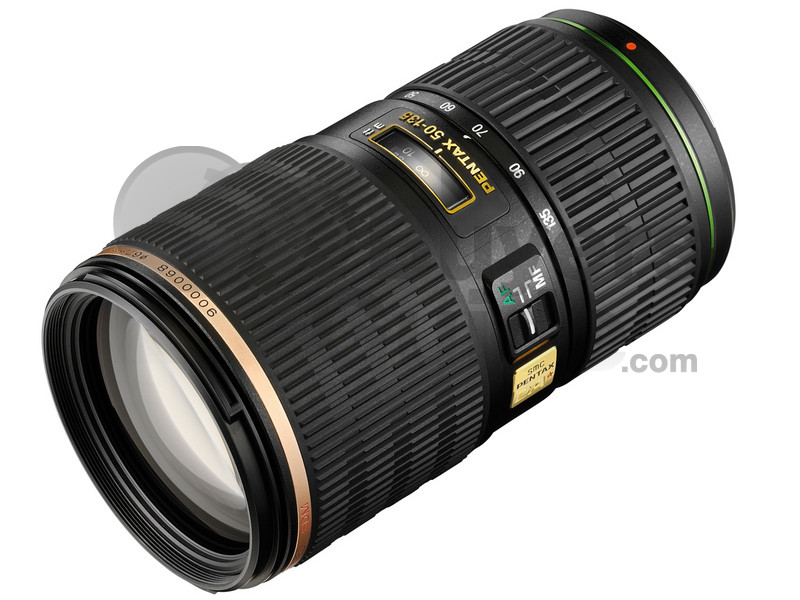
imagen de tamaño APS-CLos lentes que crean imágenes de tamaño APS-C se diseñan sólo para cámaras digitales. No se pueden usar en cámaras que tienen un sensor de imagen más grande que el formato APS-C. Estos lentes tampoco son adecuados para cámaras de película. AF UltrasónicoLos lentes con mecanismo de enfoque ultrasónico en general son más silenciosos y rápidos que los lentes de enfoque tradicional. Se usa uno o más elementos de lente de Baja DispersiónLos elementos de lente de Baja Dispersión tienden a reducir la aberración cromática. Sin estabilizadorLa estabilización de imagen ayuda a reducir el difuminado causado por el movimiento de la mano, especialmente con una longitud focal grande o en situaciones con poca luz. La estabilización de imagen puede dar una ventaja de 1 a 3 paradas sobre lentes sin estabilización, basado en la regla de reciprocidad. Montura metálicaLos lentes más baratos generalmente vienen equipados con montura plástica, mientras que los lentes profesionales más costosos tienen montura metálica. En general, las monturas metálicas duran más, y es algo útil cuando se cambian los lentes con frecuencia. Cuando una cámara se usa generalmente con un lente, el material de la montura de los lentes no es importante. Enfoque InternoLos lentes de enfoque interno no cambian su tamaño al cambiar el enfoque. El frente de la lente es fijoEl frente de lente fijo no rota durante el zoom y/o el enfoque. Esto permite al fotógrafo utilizar capuchas de lente en forma de pétalos. Los lentes de frente fijo también facilitan el uso de filtros de polarización. Sellado para ClimaLos lentes sellados para clima están protegidos del polvo y el agua. Aunque no son a prueba de agua, estos lentes se pueden usar en lluvia y otros ambientes húmedos. Algunos sellos sólo proveen protención contra polvo o agua, pero no ambos. El sellado sólo está disponible cuando se usan los lentes en un cuerpo de cámara sellado para clima. No tiene soporte para filtro de sustituciónLos filtros de sustitución se usan en aquellos lentes donde el lente frontal es demasiado grande, o el campo de visión no permite el uso de filtros tradicionales al frente de los lentes. Generalmente los lentes de ultra gran angular y telefoto brillante admiten este tipo de filtro. |
|
| Montura(s) disponible(s) | Pentax K |
| Aplicación(es) | Retrato, Deportes, Paisaje |
| Categoría(s) | Zoom telefoto |
| Multiplicador | 1.5× |
| Estabilizador | no |
| Longitud focal | 50 - 135 mm (2,7× zoom) |
| Construcción de lentes | 18 elementos en 14 grupos |
| Ángulo de visión |
35mm: N/D digital: 31.5-11.9° |
| Número de cuchillas | 9 |
| Apertura máxima | anchura: f/2,8 tele: f/2,8 |
| Apertura mínima | anchura: f/22 tele: f/22 |
| Distancia focal mínima | 1 cm |
| Aumento | 0,17× |
| Tamaño del filtro | 67 mm |
| Tamaño | ∅ 76.5 × 136 mm |
| Peso | 685 g |
| Notas |
|
| Velocidad de AF | N/D |
| Sonido de AF | |
| Enfoque interno | sí |
| Zoom interno | N/D |
| Lentes de frente fijo | sí |
| Tipo de montura | metal |
| Sellado para clima | sí |
| Filtro de sustitución | no |
| AF Ultrasónico | sí |
| Círculo de tamaño APS-C | sí |
| Elemento de lente de baja dispersión | sí |
| Estuche rígido | N/D |
| Estuche suave | incluído |
| Capucha para lentes | incluído |
| Adaptador de trípode | N/D |
6 de February de 2008
First the good: This is an impressive lens in both feel and looks. There's no mistaking that this is professional glass. For portraits and non-flash situations like stage performances, I wanted a lens that was top-notch in sharpness and overall image quality. According to the specs and the various reviews, this lens delivers...and that's why I bought it. Now the bad: I got a bad copy. When you point your camera at the intended subject and press the shutter, you expect the autofocus system to nail the focus, at least the vast majority of the time, especially with an expensive lens like this. Even a basic point-and-shoot is pretty reliable in that regard. However, not so with the DA* 50-135 copy I received. The majority of my shots are slightly off-focus, enough to not only cancel out the superior sharpness qualities of this lens, but to also ruin what would othewise be an excellent shot. This problem occurs in all types of shooting situations and camera/lens settings. What is more disappointing than having my one faulty lens is finding out that there are others who are experiencing similar problems with their DA* lenses. What I do know is that when I use any other Pentax or Tamron lenses on my K10, everything works fine (yes, I've upgraded the firmware to enable the SDM). In the few times that the focus is spot-on, I can say that the resulting image is quite impressive indeed.
For this amount of money, my tolerance to getting a bad sample is a bit less than if this had been a consumer-grade lens at half the price. I really, really want this lens to work for me the way it's supossed to because I'm a big Pentax advocate and like their recent products and direction in the D-SLR market. So I'm returing mine for another and keeping my fingers crossed. I'll update this review once I get the new copy and can then hopefully report on the superior performance capabilities of the lens.
Update (2/13/08): I was told by Amazon that they couldn't send me a replacement because of a supplier problem, so I'll be getting a refund. After further research into the professional Pentax DA* lens series and seeing a pattern of issues, it's probably best to skip it for now. I'm putting my money on the new Tamron 70-200 f2.8 due out in March. There aren't too many high-end lens options for Pentax D-SLR owners, so there's a lot of anxious folks out there waiting for the first reviews of the new Tamron to come through with hopes that it will deliver the same high level of image quality as a properly working DA* 50-135.
Update (3/2/08): So I find out from Tamron that they don't know when the 70-200 f2.8 lens will be released for the Pentax mount - possibly summer. Since I can't wait that long due to upcoming shooting events, I decided to take another chance with the DA* 50-135 from my local Calumet store. I was able to first test the lens for both focus and centering accuracy. It seemed to work fine - sold! After a number of test shots over the following days, I quickly was able to see that this is indeed a "Five Star" professonal lens. I had recently picked up the Tamron 28-75 f2.8, which is exceptionally sharp for a consumer lens, and did a number of comparison shots with the DA* 50-135. What I found was that the Pentax lens was unquestionably sharper across all apertures, but the weakest at f2.8 (although not that bad at all) with some sharpness falloff at the boarders. The SDM feature is certainly far quieter than the camera's screw-drive motor and very pleasing to have, but I'm not convinced it's any quicker. Image quality from what I've seen so far is excellent. Although the lens body is constructed of plastic, it looks and feels solid and of exceptional quality; a real joy to handle. Now if I could update my rating of this lens, I'd change it to four stars but not five - only because of the number of bad copies released. For a high-end lens, quality control should be better. So far, I'm very pleased with the performance of this professional lens.
Update (3/9/08): Well, after a week of continued testing of this lens, what I've discovered is that this lens, too, now has a focus "problem." While subjects seemed to be sharp most of the time initially, I found that more and more shots were slightly off more often. I then did a number of Point of Focus / Depth of Field tests by shooting a finely marked yardstick from above at about a 45 degree angle about five feet away. With the camera on center spot AF, I selected a point on the ruler and took a number of shots at various apertures and focal lengths. What should occur is that if your Depth of Field is say four inches in length(the area that's sharply focused), your Point of Focus should be about in the middle or just forward of that point. What I found with my second copy of the DA* 50-135 is that the Depth of Focus starts just about at the Point of Focus and goes back. With open aperture shots from f2.8 to f3.2, it's not uncommom for the DoF to occasionally start just after the PoF - and you end up with a slightly fuzzy shot. While the new K20D is supposed to allow for custom adjustment of the DoF and PoF alignment on a lens-to-lens basis (cool!), I'm not keen on keeping a sub-standard copy so that I can fix it by purchasing the new K20D. It's a boarderline issue here - the lens works most of the time, and when it does it's quite impressive. So this lens may also get returned for another, or I'll keep it and eventually have it adjusted by Pentax or "fixed" via the K20D...eventually. I guess Dirty Harry's famous quote applies to those considering the purchase of this lens: "...You gotta ask yourself a question; 'Do I feel lucky?'" My review is back down to two stars.
Update (8/16/08): I upgraded from the K10D to the K20D. The K20D's ability to adjust the auto focus system for individual lenses made it possible to finally see how good the Pentax 50-135 really is, since I had a preexisting focus issue with my copy of this lens. I don't believe there is another lens for the Pentax mount that delivers this high a degree of overall sharpness, contrast and saturation. With a K20D's auto focus adjustment cranked up to max -10 to compensate for the lens calibration issue, focus with this lens is now more accurate than any other lens I own. Just don't expect great performance for action shots (that's the Pentax auto focus system not the lens). Where this lens is a real jewel is at music concerts or stage performances with stage lighting. F2.8 at any focal length is still sharp in the center but f3.5 - f4.0 and higher is excellent overall. I've found that the K20D is the desired camera with this lens since this type of shooting may require wide open aperture and up to 2000 ISO (the K10D cannot match the K20D in lower high ISO noise and greater resolution - when NR is on). However, this would still be one of the best lenses you could use on your K10. Like other reviews on the 50-135 lens, a little more reach would be nice ...but then there's the Pentax f2.8 200mm prime (tempting). Finally, it's nice to be using a five star lens!
6 de September de 2007
After anxiously awaiting the new DA* series of lenses, I bought it the day it was released. I had to photograph the Ujena Bikini Jam in Puerto Vallarta, Mexico and KNEW that I needed the benefits of a tightly sealed, weather proof lens because of the intense humidity. When I first mounted the lens to the body of my K10D (after updating the firmware of course) I was surprised at how incredibly quiet the motor is. I've never had this experience with any lens I've owned. I'm so used to the slight "whir" sound that lenses produced, it was hard for me at first to tell if it was working! The lens focuses quickly and accurately. The lens is nicely finished with nice rubber ribbing on the barrel. It accepts 67mm thread size filters. There may be a temptation to get a standard type Skylight filter. Spend the extra money for the Super Multicoated type. After all, if you spend nearly $1,000 for a lens, why would you skimp on a lower priced filter? The manual focusing mechanism turns freely after you reach the end of the focal length on either side. This is done so that you do not damage the focusing mechanism. For manual focus option, instead of setting your camera body to manual focus, the lens has a switch that allows you to switch between manual focus and auto focus without having to have your body set on manual focus. This is convenient. If the lens is hunting you can easily click over the switch with your thumb without having to remove the camera from your eye. There is no longer an aperture ring on the new digital series lenses. This is logical since all the f-stop settings are now done on the camera body. The stunning sharpness and contrast of this lens is amazing. Distortion is practically non existant and flare is tightly controlled. Make sure you have the lens hood attached to help make sure flare is not an issue. This lens makes the lower priced lenses seem inferior by comparison. This lens is made for professionals and it shows. If you are currently looking for a professional quality Pentax zoom lens, and need the high speed of a 2.8 lens for portrait or glamour photography, this is the one to get. This is an outstanding lens from Pentax. Rush out and get it!
11 de September de 2007
Just received lens and took it to a car show....met all my expectations and then some.....posted pictures on flickr next day....Pentax has done a good job with this lens...will probably buy DA*16-50 f2.8 next...service from Amazon was great
23 de June de 2008
I love this lens. It is fast, sharp, and has an extremely rugged build. It is definitely a large, heavy lens compared to the DA 50-200MM, for example. On the other hand, the weather sealing is evident, the focusing ring is large, and all lens motion is internal. The SDM is quiet (though not quite a silent as the DA* 16-50mm) and silky smooth. Overall this lens is well worth the investment.
29 de June de 2008
The * designation of this lens is well deserved. Pentax has produced a lens that in combination with the K20D body produces superior color/tonal balance and superior sharpness characteristics. It has a solid feel, good finish, ultra quiet focusing mechanism and a firm zoom control. Also, the constant max f/2.8 aperture makes this a fast lens that allows for great low light performance, as well as excellent bokeh characteristics. And if you are looking to make a eye-popping impression on your fellow photo peers, this lens w/hood on a K10 or K20D screams "this guy knows his gear"!!
While higher in price than conventional Pentax lenses, this lens is a tremendous value compared to the premium lenses by Canon and Nikon.
By the way, great service from Amazon! This is the place to buy photo gear once you know what you want!