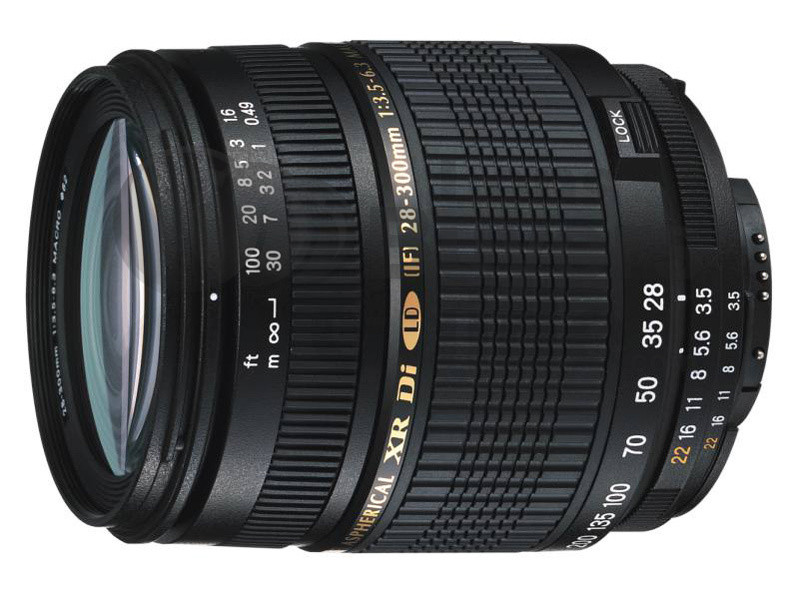
Full frame sized imageLenses that create APS-C sized image are designed for digital only. They cannot be used on cameras that have image sensor larger than the APS-C format. These lenses are not suitable for film cameras either. No Ultrasonic AFLenses with ultrasonic focusing mechanism tend to be quiter and faster than traditionally focusing lenses. One or more Low Dispersion lens element is usedLow Dispersion lens elements help to reduce chromatic aberration. Built-in image stabilizerImage stabilization helps to reduce blur caused by hand shake, especially at high focal length or in low light situations. Image stabilization can give 1 to 3 stop advantage over none stabilized lens, based on the reciprocal rule. Internal FocusingInternally focusing lenses don't change their size while setting focus. The front lens is fixedThe fixed front lens is not rotating during zoom and/or focusing. This allows the photographer to use petal shaped lens hood. Fixed front lenses also make the use of polarization filters a lot easier. No drop-in filter supportDrop-in filters are used in those lenses where either the front lens is too large, or the field of view doesn't permit the use of traditional filters at the front of the lens. Usually bright tele and ultra-wide angle lenses support this filter type. |
|
| Available mount(s) | Canon EF, Nikon F |
| Application(s) | Portrait, Closeup, Landscape, Wildlife, Architecture |
| Category(s) | Standard zoom |
| Multiplier | 1× |
| Stabilizer | yes |
| Focal length | 28 - 300 mm (10.7× zoom) |
| Lens construction | 13 elements in 8 groups |
| Angle of view |
35mm: 75-8° digital: N/A |
| Number of blades | 9 |
| Maximum aperture | wide: f/3.5 tele: f/6.3 |
| Minimum aperture | wide: f/22 tele: f/40 |
| Minimum focusing distance | 49 cm |
| Magnification | 0.33× |
| Filter size | 49 mm |
| Size | ∅ 78 × 99 mm |
| Weight | 550 g |
| Notes |
|
| AF speed | N/A |
| AF sound | |
| Internal focusing | yes |
| Internal zoom | N/A |
| Fix front lens | yes |
| Mount type | N/A |
| Weather sealed | N/A |
| Drop in filter | no |
| Ultrasonic AF | no |
| APS-C sized circle | no |
| Low dispersion lens element | yes |
| Hard case | N/A |
| Soft case | N/A |
| Lens hood | included |
| Tripod adapter | N/A |
Jan 27, 2008
I have owned and tested the Tamron 28-300mm VC zoom lens for about 2 months now. Here is an early review from my experience so far.
Pros:
Excellent optical quality (stronger at shorter focal length)
Versatile multi-purpose walk around lens. Leave this one on your camera and no need to lug around extra lenses.
Amazing focal length range 28-300 equals to 44-480 on 1.6x crop sensor.
Compact size and light weight.
Vibration compensation works very well zoomed out and in macro shots
Solid and well built quality
Rubberize grip feels much better then most Canon lenses
Reasonable price relative to comparable lenses
Included hood
Center-pinch lens cap should be an industry standard.
Extra peace of mind with standard 6 year manufacturer warranty
Cons:
Wider angle would be nice on a 1.6x crop sensor. If you shoot a lot of landscapes 44mm may not be enough.
In low light, indoor conditions, the f3.5-6.3 aperture means I have to increase the ISO and use longer shutter speeds to shoot brighter.
Occasionally, the AF searches a bit in low light shooting
Not a big deal but, the lens creeps (extends with gravity) when lens lock is off and the lens is pointing down.
In conclusion, the Tamron AF 28-300mm VC lens is an exceptional choice if you are looking for a general walk around lens to keep on your camera. You can not beat the optical performance with such range from a relatively compact, light and well-built package, especially considering the price.
Jan 25, 2008
I replaced two Canon lenses (18-135 and 70-300) with this single lens and I'm glad I did it. Most of my pictures are hand-held, on hikes or vacation, and I really don't want to carry a bunch of lenses or change them in the field. In the last year, I've been hiking on a glacier in Canada and crossing the Sahara on horseback. Neither is a great place to change lenses and there were too many times I missed a shot I wanted because the right lens was in the bag, not on the camera.
This one is small, light, easy to use. I see no color or shape distortion. I can get the same results handheld at slower shutter speeds using Tamron's VC as I got with Canon's IS.
I do have a few small gotcha's, though. One is that the direction of the twist to zoom in is opposite direction to the Canon lens. That took a bit of getting used to. Another is that auto focusing is a little louder. That might be a problem for places where silence is important. Third (and last), there is very little twist difference between 200mm and 300mm focal lengths. In other words, it is difficult to make precise choices at the upper ends of the range. (All zooms are more granular at their lower numbers; it is just that with a range this wide it is more pronounced than usual.)
All in all, I'm very happy with this lens and recommend it to you.
Jan 30, 2008
I love this lens -- an all-purpose carry-around lens with VC built in, and very good optics. I am surprised consistently by the IQ of the photos I am taking - not what I expected from a general walk-around lens of this type.
With my previous Nikon kit -- the 18-200 was one of my favorite lenses, but the IQ was always a bit worse than what I got with any of my dedicated lenses...
Now with my Canon kit, I can clearly state that the Tamron 28-300 VC lens consistently gives me far better shots that the Nikon 18-200 ever did in the same lighting situations. The added zoom is a blessing and basically allows you to take your Canon camera, this lens, and nothing else on most photo shoots, especially when traveling.
I highly recommend this lens as an all-purpose walk-around lens, and I think you will find that the IQ is stunning -- beyond what you would imagine with a lens of this type.
My only wish -- that it was 18-300 because you DO miss the wider angle from 18-28 at times...but at this price point and this quality, I can't recommend it more. You will not be sorry with this lens, and you might, like myself, find yourself basically using this for almost all situations. It hasn't come off my Canon 40D in the two months I have had both.
Feb 26, 2008
I have a Canon 1DMkII, 1Ds and a 40D. I also have the Canon lenses - 28-300mm L IS, 100-400mm L IS, 70-200mm L IS and 300mm L IS The lenses and cameras are great needless to say. However they are big, heavy (except for the 40D) and not great to carry around all day when spending the day taking photos of something when you are not looking for that ultimate quality.
The Tamron fits that need perfectly. Remember I am comparing it to the best that Canon makes so being second is not a bad thing! Combined with the 40D or a Canon XTi it makes a perfect walk around combination. You can go from wide angle to telephoto with one lens. The resolution is fine and the image stabilization performs nicely and is especially noticeable at the 300mm range.
The price is good and the build quality is good. I wouldn't buy any other lens of this type. There are reviews in Popular Photo magazine and on their web site.
Ben Lanterman
May 6, 2008
I had high hopes for this lens, and indeed it feels very good on the camera. The Vibration Compensation works great and the zoom range is exactly what I was looking for.
Unfortunately, it was really hard to take good picture with it! Most of the images were very soft and I never figured out the magic formula to make them better.
And just so you don't think I'm one of those "L" glass snobs, I'm comparing the pictures to the 18-55mm kit lens that came with my Rebel XT! When a $600 lens can't take as good of pictures as a $100 kit lens, you know there is trouble.
At first I thought it might be a focus problem, but I took some test images against a grid of graph paper and the focal plane was right where I expected it to be.
Then I thought that maybe the VC was tricking me into thinking I was taking better shots indoors than I really was, since people move around even when the camera isn't. Certainly I think this was part of the problem as the VC lets you hand-hold down to somewhere around 1/10 second exposures. But people have to hold really still not to come out soft at that speed. Anyway, that didn't tell the entire story as I also took a bunch of shots outside in good light with fast shutter speeds, and it didn't help very much.
My theory is that it is just too difficult to make a lens that covers such a diverse zoom range with sharp results. The only other one I know of that might be able to do it successfully is a Canon "L" lens, and that one costs $2300!
So for now, I'm giving up my dream of having a do-it-all superzoom lens (I returned this one) and instead bought a faster lens -- the Tamron 28-75 f/2.8, because my kids can't sit still for pictures! It was $200 cheaper than the 28-300, and takes much better pictures. The lens is very sharp, and the 2.8 aperture is fast and pretty. I don't regret dumping the 28-300 one little bit.
Jan 27, 2008
I have owned and tested the Tamron 28-300mm VC zoom lens for about 2 months now. Here is an early review from my experience so far.
Pros:
Excellent optical quality (stronger at shorter focal length)
Versatile multi-purpose walk around lens. Leave this one on your camera and no need to lug around extra lenses.
Amazing focal length range 28-300 equals to 44-480 on 1.6x crop sensor.
Compact size and light weight.
Vibration compensation works very well zoomed out and in macro shots
Solid and well built quality
Rubberize grip feels much better then most Canon lenses
Reasonable price relative to comparable lenses
Included hood
Center-pinch lens cap should be an industry standard.
Extra peace of mind with standard 6 year manufacturer warranty
Cons:
Wider angle would be nice on a 1.6x crop sensor. If you shoot a lot of landscapes 44mm may not be enough.
In low light, indoor conditions, the f3.5-6.3 aperture means I have to increase the ISO and use longer shutter speeds to shoot brighter.
Occasionally, the AF searches a bit in low light shooting
Not a big deal but, the lens creeps (extends with gravity) when lens lock is off and the lens is pointing down.
In conclusion, the Tamron AF 28-300mm VC lens is an exceptional choice if you are looking for a general walk around lens to keep on your camera. You can not beat the optical performance with such range from a relatively compact, light and well-built package, especially considering the price.
Jan 25, 2008
I replaced two Canon lenses (18-135 and 70-300) with this single lens and I'm glad I did it. Most of my pictures are hand-held, on hikes or vacation, and I really don't want to carry a bunch of lenses or change them in the field. In the last year, I've been hiking on a glacier in Canada and crossing the Sahara on horseback. Neither is a great place to change lenses and there were too many times I missed a shot I wanted because the right lens was in the bag, not on the camera.
This one is small, light, easy to use. I see no color or shape distortion. I can get the same results handheld at slower shutter speeds using Tamron's VC as I got with Canon's IS.
I do have a few small gotcha's, though. One is that the direction of the twist to zoom in is opposite direction to the Canon lens. That took a bit of getting used to. Another is that auto focusing is a little louder. That might be a problem for places where silence is important. Third (and last), there is very little twist difference between 200mm and 300mm focal lengths. In other words, it is difficult to make precise choices at the upper ends of the range. (All zooms are more granular at their lower numbers; it is just that with a range this wide it is more pronounced than usual.)
All in all, I'm very happy with this lens and recommend it to you.
Jan 30, 2008
I love this lens -- an all-purpose carry-around lens with VC built in, and very good optics. I am surprised consistently by the IQ of the photos I am taking - not what I expected from a general walk-around lens of this type.
With my previous Nikon kit -- the 18-200 was one of my favorite lenses, but the IQ was always a bit worse than what I got with any of my dedicated lenses...
Now with my Canon kit, I can clearly state that the Tamron 28-300 VC lens consistently gives me far better shots that the Nikon 18-200 ever did in the same lighting situations. The added zoom is a blessing and basically allows you to take your Canon camera, this lens, and nothing else on most photo shoots, especially when traveling.
I highly recommend this lens as an all-purpose walk-around lens, and I think you will find that the IQ is stunning -- beyond what you would imagine with a lens of this type.
My only wish -- that it was 18-300 because you DO miss the wider angle from 18-28 at times...but at this price point and this quality, I can't recommend it more. You will not be sorry with this lens, and you might, like myself, find yourself basically using this for almost all situations. It hasn't come off my Canon 40D in the two months I have had both.
Feb 26, 2008
I have a Canon 1DMkII, 1Ds and a 40D. I also have the Canon lenses - 28-300mm L IS, 100-400mm L IS, 70-200mm L IS and 300mm L IS The lenses and cameras are great needless to say. However they are big, heavy (except for the 40D) and not great to carry around all day when spending the day taking photos of something when you are not looking for that ultimate quality.
The Tamron fits that need perfectly. Remember I am comparing it to the best that Canon makes so being second is not a bad thing! Combined with the 40D or a Canon XTi it makes a perfect walk around combination. You can go from wide angle to telephoto with one lens. The resolution is fine and the image stabilization performs nicely and is especially noticeable at the 300mm range.
The price is good and the build quality is good. I wouldn't buy any other lens of this type. There are reviews in Popular Photo magazine and on their web site.
Ben Lanterman
May 6, 2008
I had high hopes for this lens, and indeed it feels very good on the camera. The Vibration Compensation works great and the zoom range is exactly what I was looking for.
Unfortunately, it was really hard to take good picture with it! Most of the images were very soft and I never figured out the magic formula to make them better.
And just so you don't think I'm one of those "L" glass snobs, I'm comparing the pictures to the 18-55mm kit lens that came with my Rebel XT! When a $600 lens can't take as good of pictures as a $100 kit lens, you know there is trouble.
At first I thought it might be a focus problem, but I took some test images against a grid of graph paper and the focal plane was right where I expected it to be.
Then I thought that maybe the VC was tricking me into thinking I was taking better shots indoors than I really was, since people move around even when the camera isn't. Certainly I think this was part of the problem as the VC lets you hand-hold down to somewhere around 1/10 second exposures. But people have to hold really still not to come out soft at that speed. Anyway, that didn't tell the entire story as I also took a bunch of shots outside in good light with fast shutter speeds, and it didn't help very much.
My theory is that it is just too difficult to make a lens that covers such a diverse zoom range with sharp results. The only other one I know of that might be able to do it successfully is a Canon "L" lens, and that one costs $2300!
So for now, I'm giving up my dream of having a do-it-all superzoom lens (I returned this one) and instead bought a faster lens -- the Tamron 28-75 f/2.8, because my kids can't sit still for pictures! It was $200 cheaper than the 28-300, and takes much better pictures. The lens is very sharp, and the 2.8 aperture is fast and pretty. I don't regret dumping the 28-300 one little bit.