
Lens finder
Sigma 18-200mm f/3.5-6.3 DC
APS-C sized imageLenses that create APS-C sized image are designed for digital only. They cannot be used on cameras that have image sensor larger than the APS-C format. These lenses are not suitable for film cameras either. No Ultrasonic AFLenses with ultrasonic focusing mechanism tend to be quiter and faster than traditionally focusing lenses. No stepping motor AFLenses with stepping motor focusing mechanism are better for contrast based focusing, and are quiter and faster than traditionally focusing lenses. One or more Low Dispersion lens element is usedLow Dispersion lens elements help to reduce chromatic aberration. Not stabilizedImage stabilization helps to reduce blur caused by hand shake, especially at high focal length or in low light situations. Image stabilization can give 1 to 3 stop advantage over none stabilized lens, based on the reciprocal rule. Metal mountCheaper lenses are usually equipped with plastic mount, while more expensive, professional lenses have metal mount. In general, metal mounts are more durable, and a good thing to have when lenses are changed a lot. When a camera is used mainly with one lens, the material of the lens mount is not that important. Internal FocusingInternally focusing lenses don't change their size while setting focus. The front lens is fixedThe fixed front lens is not rotating during zoom and/or focusing. This allows the photographer to use petal shaped lens hood. Fixed front lenses also make the use of polarization filters a lot easier. No drop-in filter supportDrop-in filters are used in those lenses where either the front lens is too large, or the field of view doesn't permit the use of traditional filters at the front of the lens. Usually bright tele and ultra-wide angle lenses support this filter type. |
|
|
This high zoom ratio lens is exclusively designed for digital SLR cameras and capable of covering a wide range of focal lengths from wide-angle to telephoto. Two Special Low Dispersion (SLD) glass elements and two hybrid aspherical lenses offer the utmost correction for all types of aberrations, and enables this extended range super zoom lens to be housed in a compact and lightweight construction of 70mm (2.8 inches) diameter, and 78.1mm (3.1 inches) in length, and weighing just 405g/14.3oz. The new lens coating reduces flare and ghost, which is a common problem of digital cameras and also creates an optimum color balance. This lens has a minimum focusing distance of 45cm (17.7inches) at all focal lengths and has maximum magnification of 1:4.4.
|


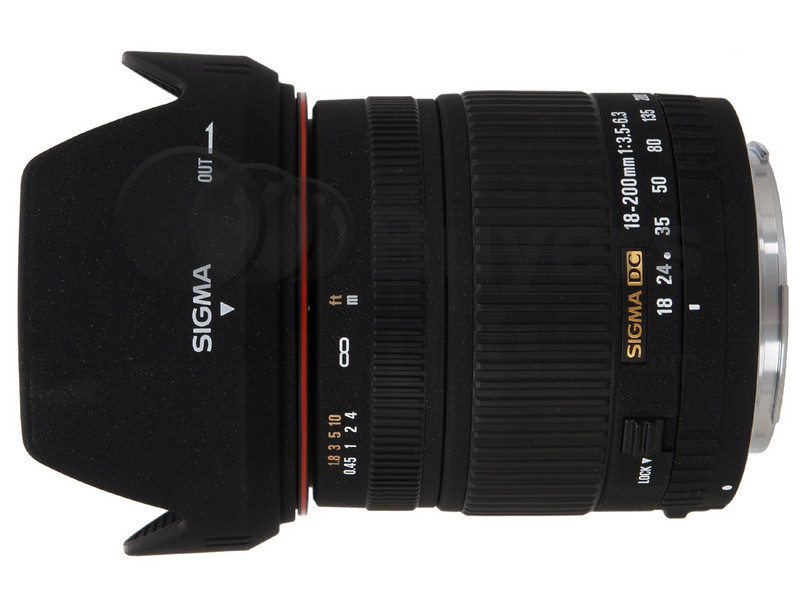


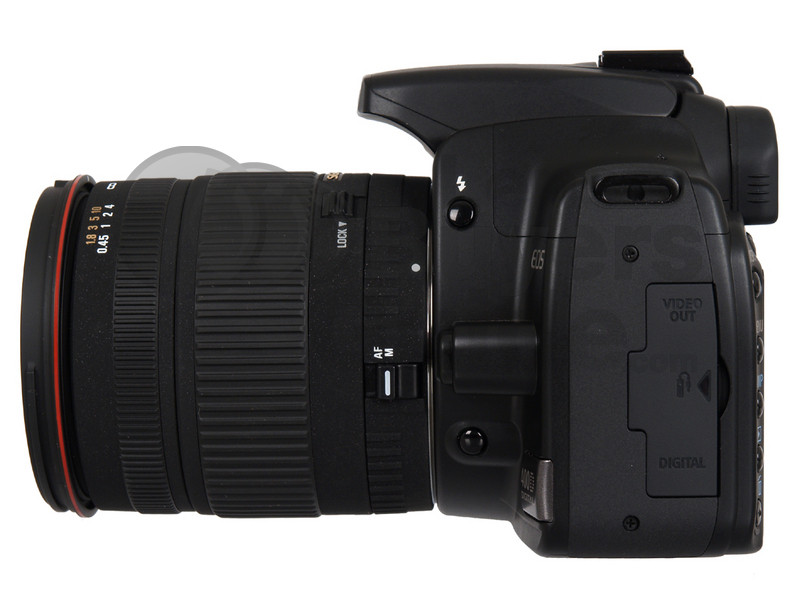
Sigma 18-200mm f/3.5-6.3 DC Specification
| Available mount(s) | Canon EF, Nikon F, Pentax K, Sony / Minolta A, Sigma |
| Application(s) | Portrait, Landscape, Wildlife, Architecture |
| Category(s) | Standard zoom, Tele zoom |
| Multiplier | 1.5× |
| Stabilizer | no |
| Focal length | 18 - 200 mm (11.1× zoom) |
| Lens construction | 15 elements in 13 groups |
| Angle of view |
35mm: N/A digital: 76.5-8.1° |
| Number of blades | 7 |
| Maximum aperture | wide: f/3.5 tele: f/6.3 |
| Minimum aperture | wide: f/22 tele: N/A |
| Minimum focusing distance | 45 cm |
| Magnification | 0.23× |
| Filter size | 62 mm |
| Size | ∅ 70 × 78.1 mm |
| Weight | 405 g |
| Notes |
At December 19, 2007, the Sigma announced a new version with built-in AF motor allowing autofocus with all Nikon APS-C DSLR cameras. The size of this model: 70 ?- 75,6 mm, and the weight is 395 g. |
| AF speed | 0.8 sec. (from close up to infinity) |
| AF sound | |
| Internal focusing | yes |
| Internal zoom | N/A |
| Fix front lens | yes |
| Mount type | metal |
| Weather sealed | N/A |
| Drop in filter | no |
| Ultrasonic AF | no |
| Stepping motor AF | no |
| APS-C sized circle | yes |
| Low dispersion lens element | yes |
| Hard case | N/A |
| Soft case | N/A |
| Lens hood |
LH680-01 printable lens hood |
| Tripod adapter | N/A |
| Discontinued | yes |
Sigma 18-200mm f/3.5-6.3 DC Reviews
Other reviews
- Sigma 18-200mm f/3.5-6.3 DC review at www.cameralabs.com (English)
- Sigma 18-200mm f/3.5-6.3 DC review at www.ephotozine.com (English)
- Sigma 18-200mm f/3.5-6.3 DC review at dc.watch.impress.co.jp (Japanese)
- Sigma 18-200mm f/3.5-6.3 DC review at pixinfo.com (Hungarian)
Sigma 18-200mm f/3.5-6.3 DC in the news
- Tamron SP AF60mm f/2.0 Di-II Macro
- Nikkor AF-S DX 85mm f/3.5G ED Micro
- Carl Zeiss Distagon T* 35mm f/2.0 ZF
- Sony SAL2875 28-75mm f/2.8 SAM
- Carl Zeiss Distagon T* 28mm f/2 with EF mount
- Tamron SP AF17-50mm f/2.8 XR Di II VC LD Aspherical
- Carl Zeiss Distagon T* 2,8/21 for EF mount
- Carl Zeiss Distagon T* 3,5/18 ZE
- SIGMA 70-300mm F4-5.6 DG OS
- Nikkor AF-S 16-35mm f/4 G ED VR