
Lens finder

Hints:
Write at least 2 characters
Try to narrow the search by typing the following: e.g. 70 300 is
If you find the content of this site useful, please purchase your lenses and accessories from our partners through this site. Thank you for your support!
$545.00
Buy now

Nikkor 18-135mm f/3.5-5.6G IF-ED AF-S DX
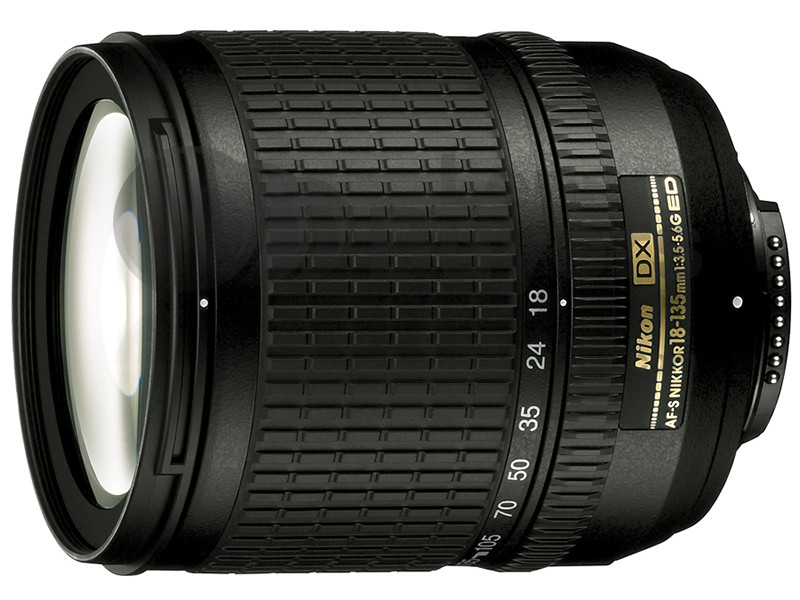
Nikkor 18-135mm f/3.5-5.6G IF-ED AF-S DX lens
 

APS-C sized image

Lenses that create APS-C sized image are designed for digital only. They cannot be used on cameras that have image sensor larger than the APS-C format. These lenses are not suitable for film cameras either.


Ultrasonic AF

Lenses with ultrasonic focusing mechanism tend to be quiter and faster than traditionally focusing lenses.


One or more Low Dispersion lens element is used

Low Dispersion lens elements help to reduce chromatic aberration.


Not stabilized

Image stabilization helps to reduce blur caused by hand shake, especially at high focal length or in low light situations. Image stabilization can give 1 to 3 stop advantage over none stabilized lens, based on the reciprocal rule.


Metal mount

Cheaper lenses are usually equipped with plastic mount, while more expensive, professional lenses have metal mount. In general, metal mounts are more durable, and a good thing to have when lenses are changed a lot. When a camera is used mainly with one lens, the material of the lens mount is not that important.


Internal Focusing

Internally focusing lenses don't change their size while setting focus.


No Internal Zoom

Internally zooming lenses don't change their size while focal length is changing.


The front lens is fixed

The fixed front lens is not rotating during zoom and/or focusing. This allows the photographer to use petal shaped lens hood. Fixed front lenses also make the use of polarization filters a lot easier.


Not Sealed

Weather sealed lenses are protected from dust and water. While they are not water proof, these lenses can be used in rain and other humid environments. Some sealings only provide protection against dust or water, not both. Sealing is only available when the lens is used on a similarly weather sealed camera body.


No drop-in filter support

Drop-in filters are used in those lenses where either the front lens is too large, or the field of view doesn't permit the use of traditional filters at the front of the lens. Usually bright tele and ultra-wide angle lenses support this filter type.

A high performance compact and lightweight 7.5x zoom lens for Nikon DX format digital SLRs

Nikkor 18-135mm f/3.5-5.6G IF-ED AF-S DX Specification

Available mount(s) Nikon F
Application(s) Portrait, Landscape, Architecture
Category(s) Standard zoom, Tele zoom
Multiplier 1.5×
Stabilizer no
Focal length 18 - 135 mm (7.5× zoom)
Lens construction 15 elements in 13 groups
Angle of view 35mm: N/A
digital: 76-12°
Number of blades 7
Maximum aperture wide: f/3.5 tele: f/5.6
Minimum aperture wide: f/22 tele: f/38
Minimum focusing distance 45 cm
Magnification 0.24×
Filter size 67 mm
Size ∅ 73.5 × 86.5 mm
Weight 385 g
Notes
AF speed N/A
AF sound
Internal focusing yes
Internal zoom no
Fix front lens yes
Mount type metal
Weather sealed no
Drop in filter no
Ultrasonic AF yes
APS-C sized circle yes
Low dispersion lens element yes
Hard case N/A
Soft case CL-0915
Lens hood HB-32
Tripod adapter N/A
Nikkor 18-135mm f/3.5-5.6G IF-ED AF-S DX Specification

Nikkor 18-135mm f/3.5-5.6G IF-ED AF-S DX Reviews

Nikkor 18-135mm f/3.5-5.6G IF-ED AF-S DX in the news

Other reviews

Nikkor 18-135mm f/3.5-5.6G IF-ED AF-S DX Owner Reviews

Most useful owner reviews from Amazon

A solid value and nothing to scoff at

Jul 2, 2007

Wide open this lens has some noticeable flaws, but if you force it to using a more closed aperture (say F8), many of those become less apparent. Even if you're forced to shoot wide open or you don't know better, you can correct the aberrations and vignetting in software.

While some prefer the slightly better build of the 18-70mm, I'd take the extra 65mm (close to 100mm on the DSLRs that use these lenses) any day over a distance scale and a metal lens mount. For crying out loud it's an autofocus walk around lens, so distance scales are relics for few people to use and the mount is a moot point, since it will stay on 99% of the time. As for focus speed, it's great. There are faster focusing lenses, but not with a comparable zoom range for the price. Nikon is not a charity, they design sophisticated lenses, build them to high tolerances, and sell them to a loyal following at a fair price. Yes a $1000 lens will be better than a $330 one, and yes a $2500 lens collection will do better than a $330 lens. I should hope so!

Enough of the weaknesses, which plenty of other folks will write about, it is a very good lens. 135mm is about as long of a lens that I would want without VR stabilization, but it works well when there is ample light. Since it's only intended for DSLRs, bumping the ISO is always an option to assure shake free shutter speeds.

Why isn't this a 5* review, well, I can honestly tell you that there are many people with defective lenses in need of repair/replacement. I believe those issues have been fixed, but it's not a good circumstance. I recommend that you be sure to buy a genuine US copy with a full warranty--don't fall for any extended warranty though, as it's got a generous 5 years from Nikon. Being to 'po boy I am, I opted for one of those refurbished ones, hoping it was a unit that was returned by someone expecting a perfect lens at a bargain price, and a double check by Nikon assured that it is and likely will always be fully functional. No regrets thus far.

Good, but not excellent

May 24, 2007

I'm a hobbiest/enthusiast not a professional, yet I've taken the time to learn terms like vignette, bokeh and about pincushion/barrel lens effect. The 18-135mm DX Nikkor lens suffers from all of them. If you're not a perfectionist or professional, then you will certainly not be disappointed by this utilitarian starter lens. If you expect to take your photography to "the next level" then this lens will quickly become a paperweight not worthy of space in your camera bag. ---

First, I've noticed vignetting (i.e., a slight darkening of the corners) at "extreme zoom" (135mm zoom). It's most noticible on skylines and photos of airborne objects. ---

Second, I've noticed slight pincushioning (the inverse of a fish-eye lens, everything is pulled towards the center of the photo, destroying square lines) at almost all zoom settings. ---

Third, the Bokeh (blur) is bad bokeh. Typically, photographers consider good bokeh to be that which is brightest in the center and gradually fades towards the edges until it merges with the blurred background. The 18-135mm lens suffers from bad bokeh, which is the blur highlight is on the edge of the blur. While this might be what you want for some artistic reason, it makes small light sources that blur in your background really stand out and detract from professional grade photographs. ---

Lastly, if you do any night shots, macro/close-up work or want to do any extended shutter photography, you will find that the lack of image stabilization (or vibration reduction as Nikon calls it) will drive you to purchase another lens quickly... unless you can work with tripod for all of your shots. ---

However, I've not suffered from any of the auto-focus issues that other customers have (although it doesn't focus well in darkness, this is not the lens's fault and there are solutions outside of the lens to solve this problem), nor have I had any defects in my lens. The photos are sharp (other than the above problems), but I have not had a chance to test (nor will I intentionally experiment with) durability. I've taken my 18-135mm on several "vacation" style outings and snapped well over 1000 shots in the first 3 weeks I owned my D80 w/ 18-135mm Nikkor Zoom lens. --- Already I'm upgrading to the 18-200mm Nikkor Zoom lens with VR. --- I wish I had not purchased this lens as part of my kit, but it has been good to me.

In summary, the 18-135mm Nikkor zoom-lens is an excellent beginner lens, but if you are a perfectionist (or professional) you would be better served to avoid purchasing the 18-135mm as part of your starter kit.

Sharp glass, but slow AF, poor distortion, and significant light fall-off.

Dec 9, 2006

The title says it all. I bought the lens because the glass is sharp, the focal length is handy, and it is lightweight and easy to use. But the light fall-off in the corners is significant unless you stop-down every shot. You'll see visible distortion at any focal length on the zoom - over 1% barrel distortion on the wide end and pincussion on the long end. The auto-focus is slow and tends to hunt, even in medium light. I wish the focus ring had distance markings, but at least I can override the AF-S with a turn of the focus knob. I plan on keeping the lens, but I am disappointed in the results. Let's just say this lens is a slight improvement over the mediocre 18-55mm kit lens.

Proof: you can't please all the people all the time.

Dec 19, 2007

Quit your beefin'...this is a fine lens!
I use this lens exclusively and just cannot understand the naysayers to its quality, speed and pincushion problems.
Wierd that I have one of the few good ones?
It balances and handles great on my DSLR and takes sharp, richly colored, pics day in and day out.
The only reason I didn't give it 5 stars is that there is some 'purple fringing' at full tele. Not major but enough to ding a star.
This lens is a great value. For those who did get a bummer lens, it may worth another try or have it fixed.
I owned the reknowned Nikon 18-200 VR for a week and frankly found it heavy, clunky and the quality was no better. I returned it and kept this one.
OK, my two cents. I LIKE this lens a lot.

Best buy for versatile lens

Mar 4, 2008

I compared this to the Nikon 18-200 VR:
1) The 18-135 is lighter and nicely balanced in handling, when mounted on the light bodies (like D-40). The 18-200 VR is much too heavy for the slight added zoom range.
2) The build quality is better than the 18-200. I got an 18-200 from the Japan factory, and it had dirt inside, inbetween lens elements! The 18-135 came perfectly clean.
3) The 18-135 has a smooth zoom barrel. While the 18-200VR has a horribly grinding zoom barrel, which sounds like it's got sand in it.
4) The zoom barrel stays put in any position, while the 18-200 does not stay in place (if you hold it vertical, it starts drifting - a LOT).
5) The focus speed is Much Faster than the 18-200. If you think this is slow, wait till you spend $ 700 for the 18-200 and have to wait while it hunts-n-pecks, focusing endlessly...
5) The VR did not give me any faster exposures. I composed the exact same shot with both lenses and got the exact same readings.
6) The only down side is the pincussioning. I agree with the other reviewers about this. But it's really only noticeable on architecture. Everything else about this lens overrides this blemish.
All-in-all, the 18-200 VR is nothing but Hype, for which they charge the consumer an extra $ 400. This is sales baloney.
I can't wait to get rid of my 18-200! I'm keeping this one.

Nikkor 18-135mm f/3.5-5.6G IF-ED AF-S DX Sample Photos

Nikkor 18-135mm f/3.5-5.6G IF-ED AF-S DX Accessories

Lens hoods for Nikkor 18-135mm f/3.5-5.6G IF-ED AF-S DX

67 mm Filters

67 mm Polarizer Filters

67 mm UV Filters

67 mm Skylight Filters

67 mm Lens Caps

Copyright 2006 - 2010 © Pixinfo Ltd. | Website design | Logo design | Server hosting | Snapfish online fotókidolgozás