Full frame sized imageLenses that create APS-C sized image are designed for digital only. They cannot be used on cameras that have image sensor larger than the APS-C format. These lenses are not suitable for film cameras either. Ultrasonic AFLenses with ultrasonic focusing mechanism tend to be quiter and faster than traditionally focusing lenses. One or more Low Dispersion lens element is usedLow Dispersion lens elements help to reduce chromatic aberration. Built-in image stabilizerImage stabilization helps to reduce blur caused by hand shake, especially at high focal length or in low light situations. Image stabilization can give 1 to 3 stop advantage over none stabilized lens, based on the reciprocal rule. Metal mountCheaper lenses are usually equipped with plastic mount, while more expensive, professional lenses have metal mount. In general, metal mounts are more durable, and a good thing to have when lenses are changed a lot. When a camera is used mainly with one lens, the material of the lens mount is not that important. Internal FocusingInternally focusing lenses don't change their size while setting focus. The front lens is fixedThe fixed front lens is not rotating during zoom and/or focusing. This allows the photographer to use petal shaped lens hood. Fixed front lenses also make the use of polarization filters a lot easier. Not SealedWeather sealed lenses are protected from dust and water. While they are not water proof, these lenses can be used in rain and other humid environments. Some sealings only provide protection against dust or water, not both. Sealing is only available when the lens is used on a similarly weather sealed camera body. No drop-in filter supportDrop-in filters are used in those lenses where either the front lens is too large, or the field of view doesn't permit the use of traditional filters at the front of the lens. Usually bright tele and ultra-wide angle lenses support this filter type. |
|
|
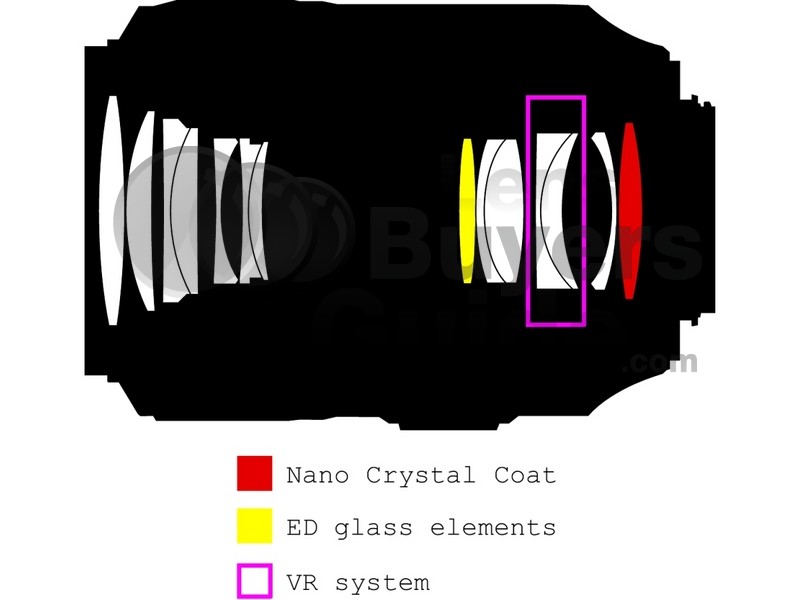
The VRII function minimizes camera shake by offering the equivalent of a shutter speed 4 stops faster at near infinity to 3m (1/30x reproduction ratio) shooting. The SWM enables fast and quiet autofocusing, and quick switching between autofocus and manual operation. ED glass element, Nano Crystal Coat ensures superior optical performance by virtually eliminating internal lens element reflections. The IF design provides a constant lens length and eliminates rotation of the front lens element, facilitating the use of circular polarizing filters and the Nikon Close-up Speedlight Commander Kit R1C1 and Nikon Close-up Speedlight Remote Kit R1. 1:1 of maximum reproduction ratio and up to 31cm closest focusing distance, Two focus modes are available — M/A and M.
|
| Available mount(s) | Nikon F |
| Application(s) | Portrait, Closeup |
| Category(s) | Telephoto prime, Macro |
| Multiplier | 1× |
| Stabilizer | yes (4 f-stop advantage) |
| Focal length | 105 mm (prime) |
| Lens construction | 9 elements in 8 groups |
| Angle of view |
35mm: 23.3° digital: 15.3° |
| Number of blades | 7 |
| Maximum aperture | f/2.8 |
| Minimum aperture | f/32 |
| Minimum focusing distance | 31.4 cm |
| Magnification | 1× |
| Filter size | 62 mm |
| Size | ∅ 83 × 116 mm |
| Weight | 790 g |
| Notes |
features close-range correciton |
| AF speed | N/A |
| AF sound | |
| Internal focusing | yes |
| Internal zoom | N/A |
| Fix front lens | yes |
| Mount type | metal |
| Weather sealed | no |
| Drop in filter | no |
| Ultrasonic AF | yes |
| APS-C sized circle | no |
| Low dispersion lens element | yes |
| Hard case | not included |
| Soft case | CL-1020 (included) |
| Lens hood |
HB-38 (included) printable lens hood |
| Tripod adapter | not included |
May 14, 2006
Here we have what appears to be a made-in-heaven lens from Nikon combining thier excellent 105 2.8 with 9 blades for better bokeh (out of focus rendering) and (gulp!) VR!!!
Well, let's cut to the chase. Is this lens worth the money? It depends. If you absolutely had your heart set on a Nikon 105 2.8 Micro, then this lens makes sense. The bokeh IS better than the older 7 bladed version. And it also has the VR which will be of aid when doing normal non-macro work. There's no denying that VR works great and combined with the 2.8 speed you get a nice package here for available light work.
My problem with this lens, as with the original, is that the Tamron 90 Macro 2.8 DI is still a better lens. It is sharper and continues to hold the lead in bokeh for protrait work. With the Tamron being under 450 new, people in the know can save and score.
On the other hand, the Nikon is HARDLY a bad lens by any stretch. We're talking about minute differences most of the time. The Nikon's VR is of very little aid doing macro work, but it's great when shooting anything else. On top of that you get VERY fast AFS focusing.
Once again I'd like to point out that a macro 105 or 90 requires close distances to subject for 1:1 work. If you want to shoot bug faces a longer focal range, such as a 150 or 180 may be better suited, though less useful for protrait work on a DSLR with a 1.5 crop ratio.
So depending on your applications, the Nikon 105 VR may still be worth the money. You have to consider how and where you'll be shooting. Optically I still feel the Tamron 90 is the lens to beat for this range in macros. But the gadget factor on this new Nikon makes for a very interesting product that will please a lot of shooters and gadget photogs alike. Enjoy!
My other lenses include: 70-200VR, 18-200VR, Tamron 90 DI Macro, 50mm 1.8, 50mm 1.4, Tokina 12-24 and so on.
Capt. RB
Mar 28, 2006
Ok, I have had this lens a couple of months now.
What at first seemed like a very good lens is now one I consider
exceptional. In fact it is now my favorite for several reasons.
First of all this lens consistently produces beautiful, even toned and complimentory Bokeh to my images. Bokeh is that term used to describe the elements of a photograph that are out of focus.
This lens has an extremely short depth of field and performs best on close subjects after f/5.6.
My observation of the VR function is this.... that Nikon intended that feature to be more useful when this lens is used for portraits. Up close and for sure when using the wider apertures depth of field is so brief that you need to stop down to capture the breadth of a bumble bee or the center of a flower completely in focus.
In either application this is destined to be a favorite Nikkor lens for many of us. For me it is already!
Focus is very fast and quiet. Build quality is solid! Hefty when held alone or nicely balanced on the D200 with MB200 battery dual battery holder.
I like the lens shade a lot and the packaging is as always, first rate. Comes with 5 year extended warranty, velvet pouch and front and rear caps.
If I could only take one lens this would be it without hesitation.
Matches up extremely well with the SB800 flash units.
I predict this will become a legendary portrait lens.
Good luck!
May 31, 2006
Pros: Excellent image quality, excellent build, excellent VR implementation
Cons: pricey, shortens focal length when focusing close, max aperture goes down to f/4.8 at closest focusing distance
Impressively, the Nikon 105/2.8 VR shows center and corner sharpness through the entire aperture range. The sweet spot is said to be between f/5.6 to f/11, but inspecting 100% crops did not reveal much loss of sharpness at the larger apertures. This probably has a good deal to do with the ED glass element and Nano Crystal coating showing its worth, but it is also probable that the lens outresolves the 6-megapixel APS-C sensor on the test body (a Nikon D50), so any decrease in sharpness is not as apparent.
Likewise, color and contrast are also consistently well rendered through the range of apertures. The only flaws in this gem are flaring and chromatic aberration, which shows up in high contrast scenes from maximum aperture (f/2.8) and is minimized by f/5.6. This is, however, typical of many large aperture lenses at maximum aperture.
Bokeh is one of the best traits of this lens, pretty much up there with some of the best Nikkor lenses, like the 85/1.4 AF-D. Out of focus areas are smooth, and the 9-bladed diaphragm helps to render out of focus point lights as circles rather than harsh geometric shapes.
My complete review, with sample photos and more detail on VR effect, AF and effective aperture, is on my webpage, check it out!
Sep 6, 2006
I have read glowing reviews of this lens in Popular Photography and posted online at various internet websites. Nikon has truly crafted a splendid update of a fine medium telephoto macro lens, offering features found on more expensive telephoto lenses such as IF (Internal Focusing) and SWM (Silent Wave Motor). Lens contrast has improved immensely with the new Nano Crystal Coat multicoating, virtually eliminating flare at all apertures from internal lens element reflections, especially wide open at f2.8; which means that this lens is well-suited for users of both Nikon film and digital autofocus SLR cameras, and also those who use only manual-focus Nikon SLR cameras. Another major improvement is the SWM feature (Silent Wave Motor) which allows for easy switching between autofocus and manual focus modes. The IR (internal Focus) feature will allow photographers to focus the lens without any shifts in barrel movement, helping to minimize camera shake during photography. Another useful addition is Nikon's image stabilizer, known as VF, which will allow photographers up to hand hold lenses at the equivalent shutter speeds that are four stops faster; it is a feature most useful for panning shots, such as in action and sports photography, not closeup or macro photography. The additional of two more aperture blades to this lens, will help enhance its already fine bokeh, making out-of-focus areas more lovely to behold, with less distracting, rounded shapes due to this lens's new 9-bladed rounded aperture diaphragm (In plain English, this should be an ideal portrait lens for fashion or wedding photography.). Historically Nikon has been one of the leading innovators in macro lens design; this new 105mm f2.8 Micro Nikkor is a splendid addition to this proud history of optical innovation; based on the reports I have read it is unquestionably the best 105mm Micro Nikkor lens ever made.
Mar 3, 2007
This lens is solidly built, sharp with excellent color and bokeh. I bought my copy off of Amazon and have been using it for several weeks now. The VR works surprisingly well in micro situations, I was able to shoot 1:1 inside a large bright greenhouse. It's nice to know that it's possible to shoot off the tripod, if the opportunity arises.
The lens does a great job on landscapes and portraits. The color and bokeh are terrific. It not as razor sharp as the Tamron, which is a good thing when you are shooting portraiture as you do not want to see every pore.
If you're looking for a micro that can do additional duty as a portrait and landscape lens, then this is definitely the one to consider. If you want to shoot primarily in micro mode and don't mind the lower build quality, the Tamron is a fantastic lens, and you save some serious cash. It's going to be an expensive purchase one way or another, check out some of the images for yourself by searching for the lens on Flickr or [...]
[...]