Objektive finden
Olympus Zuiko Digital ED 50mm f/2.0 Macro
Kein Ultraschall AFObjektive mit Ultraschall-Fokuseinstellung sind meistens schneller als Objektive mit normaler Fokuseinstellung. No stepping motor AFLenses with stepping motor focusing mechanism are better for contrast based focusing, and are quiter and faster than traditionally focusing lenses. Ein, oder mehr Linsenelement(e) mit niedriger Dispersion ist eingebautLinsenelement mit niedriger Dispersion helfen kromatische Aberration zu minimieren. Nicht stabiliziertImage stabilization helps to reduce blur caused by hand shake, especially at high focal length or in low light situations. Image stabilization can give 1 to 3 stop advantage over none stabilized lens, based on the reciprocal rule. MetallbajonettPresigünstigere Objektive haben meistens Plastikbajonetten, während teure, professionelle Objektive mit Metallbajonetten ausgestattet sind. Im Allgemeinen sind Metallbajonette dauerhafter, und praktisch wenn die Objektive oft getauscht werden. Wenn ein Kamera meistens nur mit ein Objektiv verwendet wird, speilt das Material des Bajonetts keine wesentliche Rolle. Keine interne FokuseinstellungDie Länge von Objektive mit interner Fokuseinstellung bleibt unverändert während der Fokuseinstellung. The front lens is fixedThe fixed front lens is not rotating during zoom and/or focusing. This allows the photographer to use petal shaped lens hood. Fixed front lenses also make the use of polarization filters a lot easier. WetterfestWetterfeste Objektive sind staub- und spritzwasserresistent. Obwohl sie nicht wasserdicht sind, können sie im Regen oder unter anderen feuchten Bedingungen benützt werden. Einige Dichtungen geben nur Schutzt gegen Wasser oder Staub, und nicht beides. Die Resistenz gegen Feuchte und Staub kann nur ausgenützt werden, wenn das Kameragehäuse auch entsprechenden Schutz bietet. Kein einschiebbare FilteruntersctützungEinschiebbare Filter werden bei Objektiven verwendet, die entweder zu gross sind, oder aufgrund des Winkelbereichs keinen traditionellen Filter vor dem Objektiv zulassen. Im Allgemeinen unterstützen Teleobjektive mit hochen Belichtungswerten und Ultra-Weitwinkelobjektive solche Filter. |
|




Olympus Zuiko Digital ED 50mm f/2.0 Macro Spezifikationen
| Geführte Bajonetten | FourThirds |
| Verwändungsbereiche | Porträt, Nahfoto, Panorama |
| Produktgruppen | Tele Fix, Makro |
| Multiplizierer | 2× |
| Stabilizierer | Nein |
| Brennweite | 50 mm (Fix) |
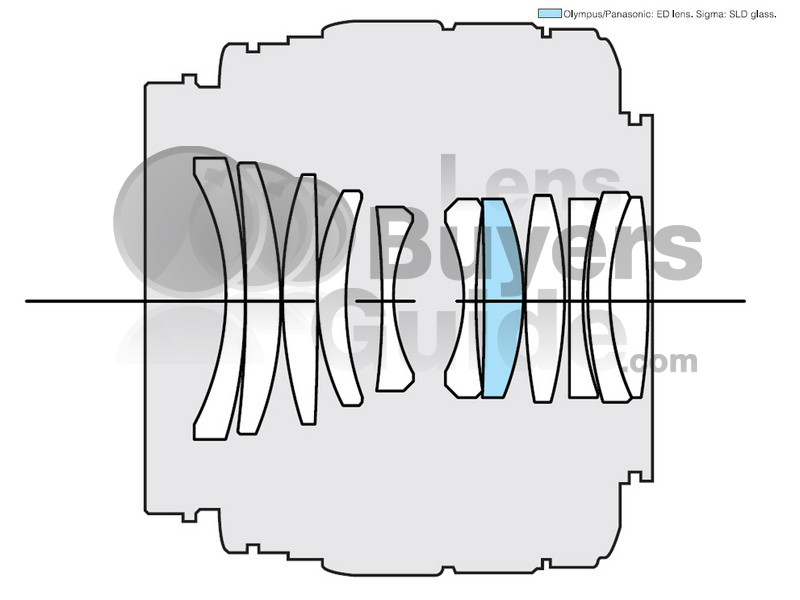
| Objektivaufbau | 11 Elemente in 10 Gruppen |
| Winkelgrösse |
35mm: N/A Digital: 24° |
| Lamellenzahl | 7 |
| Grösste Blendenöffnung | f/2 |
| Kleinste Blendenöffnung | f/22 |
| Minimum Fokusdistanz | 24 cm |
| Vergrösserung | 0,52× |
| Filtergrösse | 52 mm |
| Grösse | ∅ 71 × 61.5 mm |
| Gewicht | 300 g |
| Kommente |
|
| AF Geschwindigkeit | N/A |
| AF-Ton | |
| Interne Fokuseinstellung | Nein |
| Interner Zoom | N/A |
| Fix Frontlinse | Ja |
| Bajonett Typ | Metall |
| Wetterfest | Ja |
| Einschiebbares Filter | Nein |
| Ultraschall AF | Nein |
| Stepping motor AF | Nein |
| APS-C grosses projektiertes Bild | N/A |
| Linsenelement mit niedriger Dispersion | Ja |
| Hartes Etui | N/A |
| Weiches Etui | LSC-0814 (Zubehör) |
| Gegenlichtblende |
LH-55 (Zubehör) Druckbare Gegenlichtblende |
| Standadapter | N/A |
| Nicht mehr geführt | Ja |
Olympus Zuiko Digital ED 50mm f/2.0 Macro Testergebnisse
Other reviews
- Olympus Zuiko Digital ED 50mm f/2.0 Macro Bewertung bei www.ephotozine.com (Englisch)
- Olympus Zuiko Digital ED 50mm f/2.0 Macro Bewertung bei dc.watch.impress.co.jp (Japanisch)
- Olympus Zuiko Digital ED 50mm f/2.0 Macro Bewertung bei www.dpreview.com (Englisch)
- Olympus Zuiko Digital ED 50mm f/2.0 Macro Bewertung bei pixinfo.com (Ungarisch)
Olympus Zuiko Digital ED 50mm f/2.0 Macro in the news
- Tamron SP AF60mm f/2.0 Di-II Macro
- Nikkor AF-S DX 85mm f/3.5G ED Micro
- Carl Zeiss Distagon T* 35mm f/2.0 ZF
- Sony SAL2875 28-75mm f/2.8 SAM
- Carl Zeiss Distagon T* 28mm f/2 with EF mount
- Tamron SP AF17-50mm f/2.8 XR Di II VC LD Aspherical
- Carl Zeiss Distagon T* 2,8/21 for EF mount
- Carl Zeiss Distagon T* 3,5/18 ZE
- SIGMA 70-300mm F4-5.6 DG OS
- Nikkor AF-S 16-35mm f/4 G ED VR