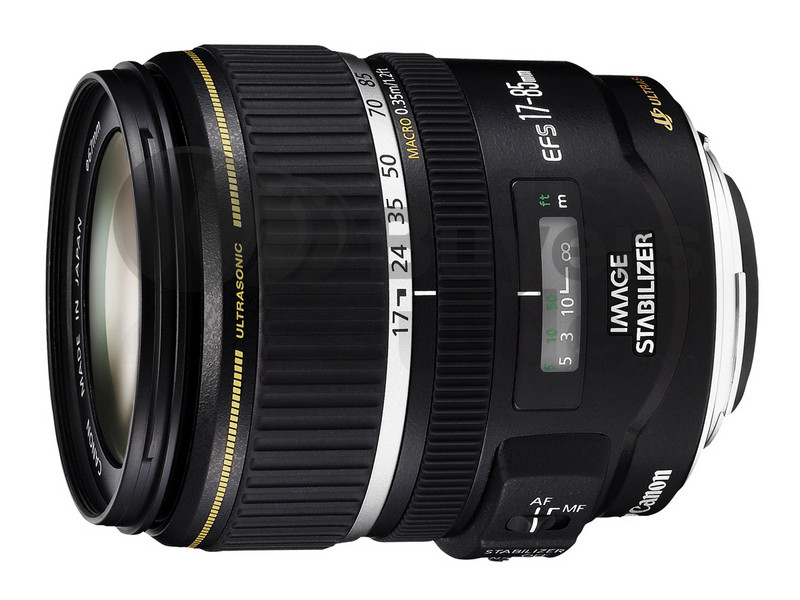
APS-C大小的影像可產生APS-C大小影像的鏡頭只屬數碼屬性,它們不可使用於比APS-C 格式更大的影像接收器,也不適用於菲林相機。 超聲波自動對焦一般來說,超聲波對焦鏡頭比傳統對焦鏡頭靜和快。 無使用低散光度鏡頭元素低散光度鏡頭元素能減低彩色的色差。 嵌裝的影像穩定器影像穩定器能減低手震時產生的模糊影像,特別在長焦距或陰暗情況下。根據倒數的定律,影像穩定化比無影像穩定鏡頭能有1到3個光圈優點。 金屬接腳平價鏡頭通常會使用塑膠接腳,而較昂貴的專業的鏡頭會使用金屬接腳。一般來說,金屬接腳會比較耐用的及當鏡頭改變很多。當相機主要使用一個鏡頭,接腳物料並不是很重要。 內置對焦內置對焦鏡頭不會因設定焦點而改變其大小。 無內置變焦內置變焦鏡頭不會因改變焦距而改變其大小。 固定前鏡頭固定前鏡頭在變焦及/或對焦時不會轉動,故可容許攝影師用花瓣狀遮光罩,固定前鏡頭能更容易利用極化濾鏡。 無天氣密封天氣密封鏡頭可防止塵埃及水份浸入。當鏡頭不是防水的,此類鏡頭可適用於下雨及朝湿環境。有些密封只可防水或防塵。天氣密封只適用於類似天氣密封相機內。 無插入濾鏡支援插入濾鏡使用於那些前鏡頭過大或視野不容許於鏡頭前傳統濾鏡的鏡頭。通常遠攝及超廣角鏡頭支援這類濾鏡。 |
|
| 可用的接環 | Canon EF-S |
| 應用 | 人像, 近攝, 風景, 建築物 |
| 類目 | 標準變焦 |
| 倍增器 | 1.5× |
| 穩定器 | 是 (3光圈值優點) |
| 焦距 | 17 - 85 mm (5× 變焦) |
| 鏡片組 | 12 群組含有17 元素 |
| 視角 |
35毫米: 不適用 數碼: 78.5-18.4° |
| 葉片數目 | 6 |
| 最大光圈 | 廣角: f/4 遠攝: f/5.6 |
| 最小光圈 | 廣角: f/22 遠攝: f/32 |
| 最短焦距 | 35 cm |
| 放大 | 0.28× |
| 濾鏡大小 | 67 mm |
| 大小 | ∅ 78.5 × 92 mm |
| 重量 | 475 g |
| 記錄 |
|
| 自動對焦速度 | 不適用 |
| 自動對焦聲音 | |
| 內置對焦 | 是 |
| 內置變焦 | 否 |
| 固定前鏡頭 | 是 |
| 接駁類型 | 鐵 |
| 天氣密封 | 否 |
| 插入濾鏡 | 否 |
| 超聲波自動對焦 | 是 |
| APS-C大小的圈 | 是 |
| 低散光度鏡頭元素 | 否 |
| 硬機殼 | 不適用 |
| 軟機殼 | LP1116 |
| 遮光罩 |
EW-73B 可印刷的遮光罩 |
| 三腳架接合器 | 不適用 |
15 October 2004
I have been using this lens for a week and getting absolutely flawless pictures - no flares, fringing etc. I also did some semi-controlled tests with Image Stablizer and it works as advertised, resulting in much sharper pics indoors. USM focusing works great too, and the lens is/feels well built.
One gripe - at $600, I would have liked it to come with a hood ("sold" separately but not available yet) and a case (also "sold" separately).
The real question IMO is not whether it's a great lens or not, but whether it's worth $600 as opposed to the kit lens (EF-S 18-55) + EF 28-135 IS. This combo is $100 cheaper and gives greater coverage on the telephoto end. On the other hand, EF-S 17-85 lens claims to have better optics, circular aperture, convenience of a single workhorse lens and IS on the wide end too.
Ultimately it's your call. My take is that if you spend $800 to $1500 on a digital SLR, you owe it to yourself to spend $600 on good lenses (and another $200 on 420ex flash ;-).
23 December 2005
Then you might consider getting a copy of the Canon EF 17-85 IS. If you have a Digital Rebel, XT, or 20D and have been shooting with a kit lens, this is one of the lenses that a lot of people buy as their first upgrade. Some people just buy it in place of the kit lens when they purchase the camera body. It's an extremely popular lens because the range and size are just right for taking anywhere. I personally debated getting this lens because I wasn't sure about the quality of the glass and my main concern was that it wasn't fast enough for all occasions. One of the more frustrating things for me about the kit lens, as great as it was for such minimal cost, was that the aperture wasn't fixed. I found myself having to bump up the ISO to make up for the lack of an f-stop or two. For those who are new to photography, that basically means you have to compensate for the fact that the lens can't let enough light into the sensor so you have to make the sensor more sensitive (but also at the cost of lower quality and more grainy results) with the higher ISO setting.
I decided I didn't want to take that risk and went all out since it was supposed to be my walk-around lens that I'd carry all the time. I picked up the expensive EF 24-70 f/2.8L lens that so many pros use because I thought it had a decent enough focal length range and at 2.8 it was fast enough for all my lightning needs. It cost $1100 and after actually hanging it around my neck, I decided it wasn't going to work for my current needs. The lens itself is relatively huge and weighs a ton on a 20D. I returned the lens after talking to a friend who is a professional photographer who basically recommended picking up the 17-85 IS. He owned both (among others) and said that it was perfect for walking around because it had both the wide end and a decent telephoto length. That and it cost half as much! He allayed all my fears that the picture quality wouldn't be very good. I was also going to be taking a trip for a few weeks to Europe and really wanted a lens that could do it all. So I bought it and have been pretty happy with my results.
Is it a pro lens? Not by any means. I know that if I kept the 24-70 the results would probably be better. But that being said, I am getting good results for half the price. When I was in Europe having the 17-85 range was about as perfect as I could have wanted. It was light and small enough that I could fit it into my compact Tamron Velocity 6 bag and the additional weight was negligible. The IS is a nice feature but don't think that it makes up for the lack of aperture width. I tried to fool myself into thinking that when I bought the lens, but I see now that having a fixed 2.8 is something you just can't make up with IS. But other than that, I'm very satisfied with this purchase. Another lens you might want to look into if you're checking this one out is the Canon EF 17-40 f/4. It's comparable in price, has a fixed f/4 but just doesn't have the additional zoom length to it. Pictures are great though and it's also relatively compact. To learn more about this and other lenses, check out a site I made for Canon Digital SLR users at www.eosrebels.com. Hopefully you'll find it helpful in deciding which walkaround lens is right for you.
21 October 2004
I bought this lens with a EOS 20D. The lens is reasonably sized, and the pictures looks sharp and overall very nice. However, the maximum aperture of this lens is 4.0, and in fact beyond 50mm (80mm equivalent) it goes down to 5.6. The IS works great and compensates for this fact iin low-light conditions quite well, but it can't give you the depth of field of larger apertures. I ended up buying a 50mm 1.4 (about $300) and boy is that a nice, sharp, fast lens. You can't go wrong by buying both.
3 October 2005
I bought this lens to be used with my 20D. The focal length range is quite impressive and can be very useful for DSLRs with an APS-C size sensor.
However, the first thing I noticed is that there is extremely high vignetting/light fall off at 17mm. There is a dark circle surrounding the frame and is very visible when the edges of the frame have high luminosity. If you snap on a UV filter or a polarizer, you can forget about taking pictures at 17-20mm. That's a huge loss.
Secondly, the picture is very soft up to f/8 or so. My control over exposure time and the depth of field is minimal at this aperture. Image Stabilizer works only at around 1/40 seconds or less. During longer exposure times, pictures still show camera shake.
Third, Canon, on it's website doesn't give MTF charts for this lens. It's available for all other lenses including their cheap consumer zooms. May be they figured this wasn't worth $600 and didn't want to publicize it.
Bottomline: If you are point-and-shoot photographer that has a DSLR for kicks, then go ahead and get this lens. It's one all-purpose lens for a 350D or a 20D. But if you are serious about photography, avoid it. I later bought a Tamron 28-75mm f/2.8 XR Di and a Tamron 17-35mm f2.8-4 XR Di. Together it costed $800. For the quality of their optics and the f2.8 constant max aperture, I happily gave up IS and USM. To top it, Tamron gave an $80 mail-in rebate and a standard 6 year warranty.
I returned the lens to Amazon for a full refund, and I haven't had a more pleasant experience than their return process. In the last 5 years that I've done business with Amazon, this was my first return. They give you a UPS packing slip which you print out and stick to the package before handing it over to the UPS driver. Within a week, the refund was processed.
13 January 2005
I am a Canon fan, their products in general are superior to others, however this lens is not up to the mark: it is undoubtedly the slowest lens on the market, at 17mm it is an F4 and by the time one tunes for 50mm it is an F5.6, making it a stretch to use it in daylight without a tripod. Canon's mammoth 1200mm is an F5.6 and the average 50mm is an F 1.4, so for what purpose is there a 50mm that always thinks its dark outside? The 5x zoom is useful having a wider zoom range than most any lens available, however the trade off is a very dark and slow lens, Canon then compensates by sticking the marginally useful image stabilizer on it because one is always shooting at 1/20 due to this inferior design. (Canon's pricey 24-70mm is an F2.8 for example, twice as fast.) Its focus in general is poor, never sharp and always a long focal field, forget the portrait with the blurred background, its not going to happen at F5.6. It has some use as a light weight walking around lens for shooting small shots at a high ISO for newspapers or such, but not a pro lens, not by a mile, barely an acceptable consumer lens.