No Ultrasonic AFLenses with ultrasonic focusing mechanism tend to be quiter and faster than traditionally focusing lenses. One or more Low Dispersion lens element is usedLow Dispersion lens elements help to reduce chromatic aberration. Not stabilizedImage stabilization helps to reduce blur caused by hand shake, especially at high focal length or in low light situations. Image stabilization can give 1 to 3 stop advantage over none stabilized lens, based on the reciprocal rule. Metal mountCheaper lenses are usually equipped with plastic mount, while more expensive, professional lenses have metal mount. In general, metal mounts are more durable, and a good thing to have when lenses are changed a lot. When a camera is used mainly with one lens, the material of the lens mount is not that important. Internal FocusingInternally focusing lenses don't change their size while setting focus. No Internal ZoomInternally zooming lenses don't change their size while focal length is changing. The front lens is fixedThe fixed front lens is not rotating during zoom and/or focusing. This allows the photographer to use petal shaped lens hood. Fixed front lenses also make the use of polarization filters a lot easier. No drop-in filter supportDrop-in filters are used in those lenses where either the front lens is too large, or the field of view doesn't permit the use of traditional filters at the front of the lens. Usually bright tele and ultra-wide angle lenses support this filter type. |
|
|
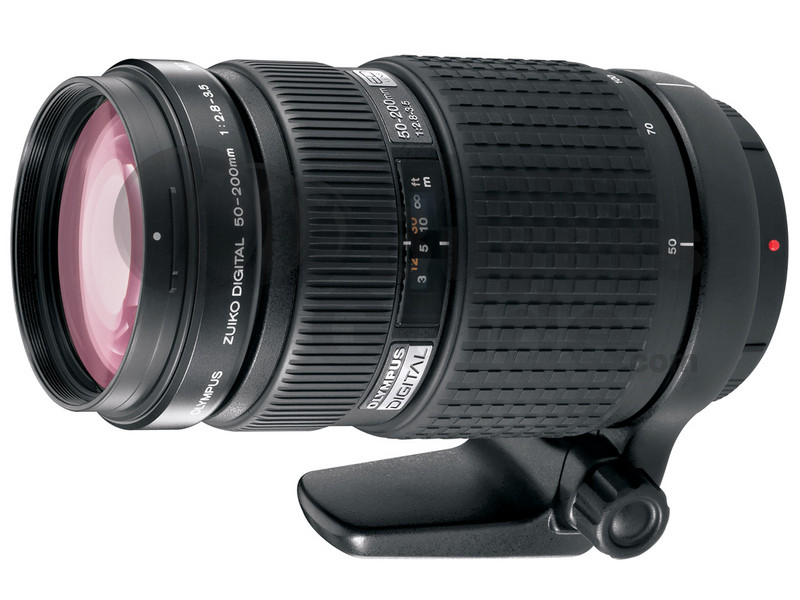
One of the lightest and most compact lenses in its class. Weighing in at just 1070 g including its tripod adapter, this versatile lens will easily go where you go to bring distant subject up close, in perfect focus with amazing clarity and color.
|
| Available mount(s) | FourThirds |
| Application(s) | Portrait, Sports, Wildlife |
| Category(s) | Tele zoom |
| Multiplier | 2× |
| Stabilizer | no |
| Focal length | 50 - 200 mm (4× zoom) |
| Lens construction | 16 elements in 15 groups |
| Angle of view |
35mm: N/A digital: 24-6° |
| Number of blades | 9 |
| Maximum aperture | wide: f/2.8 tele: f/3.5 |
| Minimum aperture | wide: f/22 tele: N/A |
| Minimum focusing distance | 120 cm |
| Magnification | 0.21× |
| Filter size | 67 mm |
| Size | ∅ 87 × 157 mm |
| Weight | 1070 g |
| Notes |
Weight: with tripod adapter |
| AF speed | 0.5 sec. (from close up to infinity) |
| AF sound | |
| Internal focusing | yes |
| Internal zoom | no |
| Fix front lens | yes |
| Mount type | metal |
| Weather sealed | N/A |
| Drop in filter | no |
| Ultrasonic AF | no |
| APS-C sized circle | N/A |
| Low dispersion lens element | yes |
| Hard case | N/A |
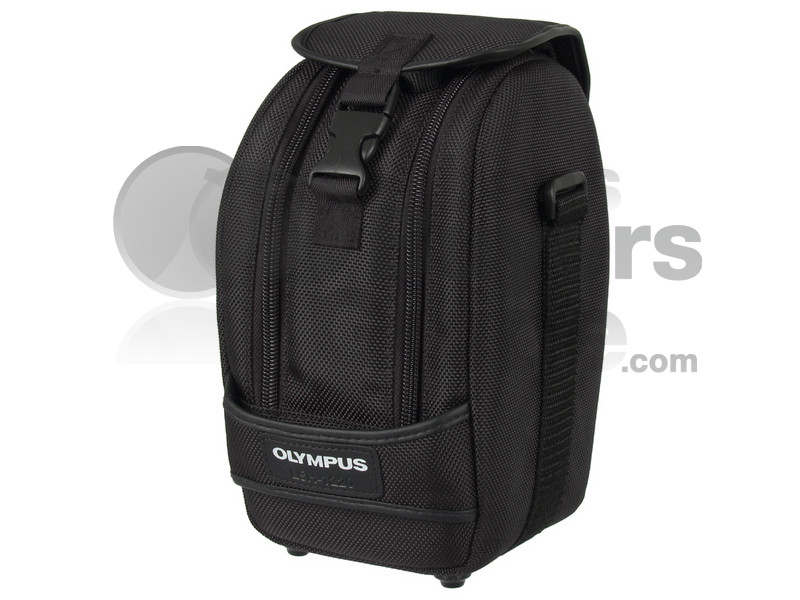
| Soft case | LSC-1220 (included) |
| Lens hood |
LH-70B (included) printable lens hood |
| Tripod adapter | included | Discontinued | yes |
Jul 4, 2006
Wow. I just got it. And already I can't say enough. I love this lens. The pictures are wonderful.
Given like many of you, I have limited means, I feel vindicated about my decision to save up (I understand how you feel attempting to reconcile the cost of this lens vs. the cost of your camera... some of us will spend more on THIS lens than the camera body...ouch! ...right now that'd be everyone save the E-330 crowd and the Panasonic DMC-L1) and BUY THIS ONE.
Understand, the advantage this lens gives you is a larger max aperture (f2.8-3.5) at all focal lengths which translates into much better action shots (your subject is in focus and your background is blurred) and greater opportunity for low light images (e.g., candlelight) at a better ISO (e.g., you might get away with ISO 200 on a shot instead of 400 translating into less noise). Couple that with the knowledge that your 50-200mm lens functions as a 100-400mm (factor is 2x given the 4/3rds sensor size compared to a 35mm frame) and you've got a lens that is as versatile as it is beautiful. Your only downside is that it is heavy, so you're going to have to either start working out or for long shoots (e.g. your kid's soccer match) bring the monopod (there is a well centered mount that comes with the lens).
In any event, why would you buy this lens? The same reason you'd make any purchase surrounding your camera setup. Because you're after GREAT pictures (leave the average stuff to the point and shoot crowd). With this lens on the end of your Olympus E Series camera, you can get there. So start saving (time for a garage sale?) and soon you'll be the envy of the soccer pitch, football field, and dance recital with your beautiful, versatile Olympus 50-200mm Zuiko f/2.8-3.5 ED lens that you, with great wisdom and foresight, bought because you're taking great pictures...
Oct 7, 2005
In many ways this is part of the matched set with the 14-54mm f2.8-3.5 lens. They both are similar in f stops and both can use the same set of filters.
The commonality is ends there though. This lens is noticably higher in quality. If I were taking two otherwise identical pictures at 50mm f4, you could see the difference, especially on prints larger than 4 x 6 (10cm x 15cm).
This is a heavy camera and with the hood it is huge too. When you take picture with it, you point the lens and the camera follows along.
Pros:
* Great bokeh
* Shares filters with 14-54mm f2.8-3.5
Cons:
* Because its closest focus distance is 1.2m, it is not the best bug or flower camera
* Heavy
Apr 5, 2006
This was the second lens I got for my E-500. The combination is superb. The lens is fast focusing and razor sharp wide open. I had the 40-150 to compare, as well as canons 70-200 f4L on a rebel xt. This lens is sharper, has better contrast and is faster, worth every cent.
Feb 14, 2007
I cannot recommend this lens highly enough if you feel you need a lens with this much telephoto reach. For those of you who have "old school" experience, this lens is about as large and heavy as those 70-210mm zoom lenses that became ubiquitous with 35mm SLRs back in the day, but it has a more solid and beefy feel to it. It's a very well crafted bit of kit without question.
I would have to say that the defining characteristic of this lens is its' reputation of being razor sharp from edge to edge, even at maximum aperture. It's simply stunning. I have to disagree with another reviewer in that I don't find the bokeh to be particularly great unless one shoots wide open (in which case it's very good indeed), but excellent sharpness with so-so bokeh seems to be a characteristic that this lens shares with it's sister lens the Zuiko 14-54mm zoom.
Autofocus speed is only average, but accuracy on my E-500 is excellent. Camera handling is compromised with such a large lens, but removing the tripod mounting foot subtracts a considerable bit of weight from the combination. The lens hood is absolutely huge and I wonder if one significantly smaller wouldn't have sufficed for 90% of user's needs, but it is well made and I have toyed with the idea of buying a second and turning it down to about 1/2 the length of the standard hood just for those days when I don't need a lens hood that's nearly as long as my lens.
In summary: This is one of the best lenses in the Digital Zuiko line and as long as you are prepared for a large lens you will very likely be highly pleased with this lens because it performs optically so very well.
Feb 13, 2007
I've had my E1, 14-54 and 50-200 for over two years now. They have performed flawlessly. As all Olympus bodies have automatic sensor cleaning, and all three are weather and dust sealed, in over 20,000 photos I've never had to worry about dusty or rainy conditions. I've taken pictures on the beach in windy conditions, indoors at school concerts handheld in low light, and in pouring rain. I've always been delighted with the pictures I get, and the 50-200 is a star performer. It's very sharp, compact for the reach (400mm 35mm equivalent) and speed it gives. And I've since bought the 7-14, giving me an incredible range coverage in 3 lenses.